

In B2B marketing, confidence isn't a personality trait—it's a measurable capability. Discover what separates the 39% of marketers who can prove their financial impact from everyone else.
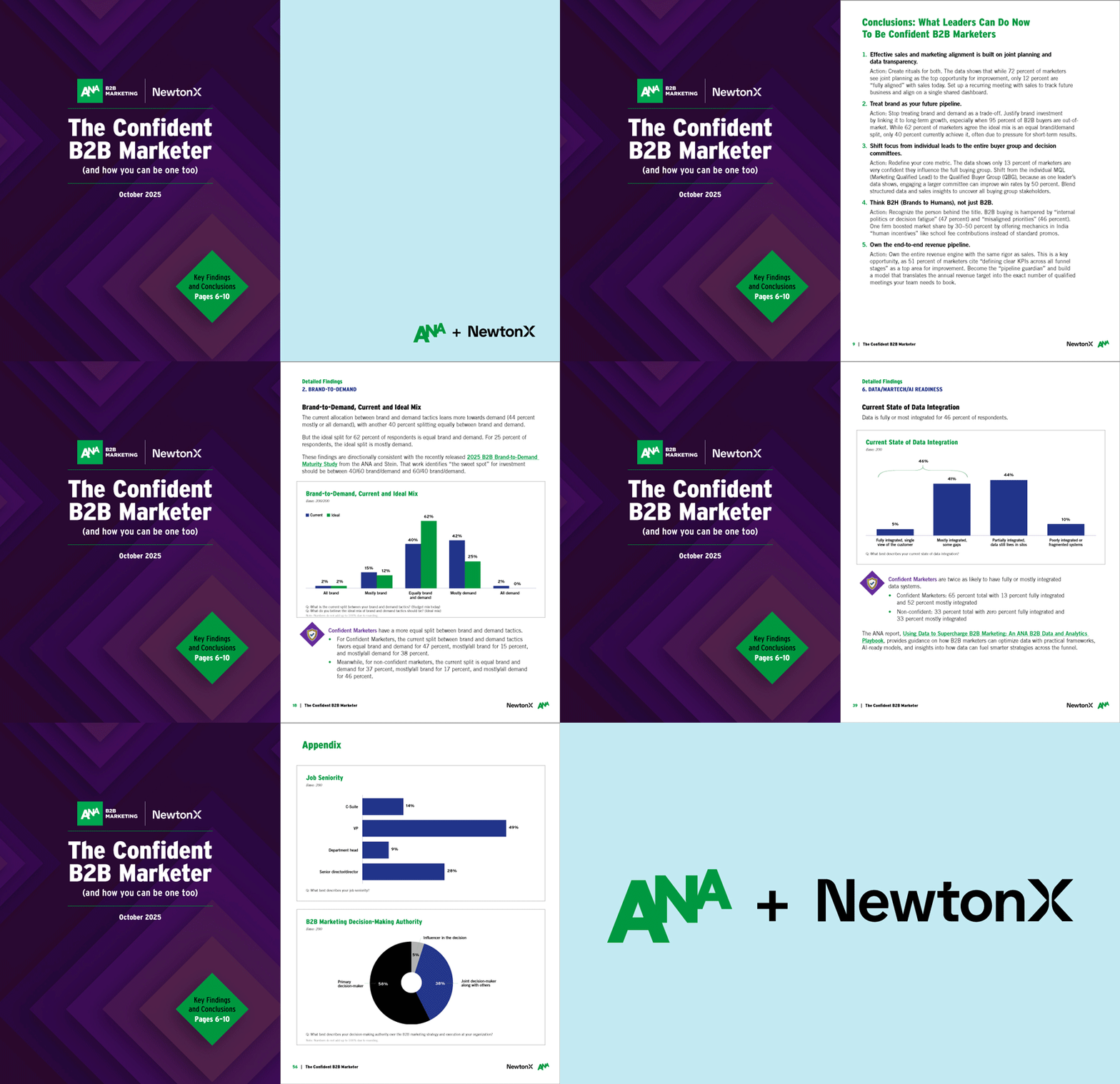
What separates top-performing B2B marketers from the rest? This report from the Association of National Advertisers (ANA) and NewtonX provides a path to the answer: the ability to prove marketing's financial impact. Based on a study of 200 senior B2B leaders, our research reveals that only 39% possess this confidence. This pivotal group, "The Confident B2B Marketer," achieves superior results through a distinct set of capabilities. Inside, you'll find their actionable blueprint for mastering sales alignment, AI readiness, and measurement to drive and demonstrate genuine commercial growth.
1. The Confidence Advantage
A key takeaway is the "Confidence Advantage". The research finds that only 39% of B2B marketers are confident in their ability to measure marketing's financial impact. This capability is what separates top performers, as it directly links to greater strategic influence and trust within the organization
2. The Impact of Sales and Marketing Alignment
The research reveals that elite marketers have solved sales alignment. 'Confident Marketers' are nearly four times more likely to report a "fully aligned" relationship with sales, characterized by shared goals and joint planning (22% vs. 6%). This alignment acts as a significant performance multiplier, with one leader noting it can boost demand generation by 3-5 times.
3. The AI & Data Readiness Divide
A major finding is the stark divide in AI readiness, which hinges on data maturity. Confident Marketers are over four times more likely to have a data ecosystem prepared for AI-driven personalization at scale (48% vs. 11%). This highlights that an integrated, high-quality data foundation is the critical prerequisite for any successful AI strategy.
4. The Shift from Leads to Buying Groups
The study shows a strategic shift away from individual leads to focusing on the entire buying committee. Confident Marketers are three times more likely to be very confident their marketing influences the full group (22% vs. 7%). The research validates this approach, with data showing that engaging a larger committee can improve win rates by 50%.
5. Justifying Long-Term Brand Investment
Confident Marketers champion long-term brand building, striking a balance with short-term demand generation. They are nearly twice as likely to increase brand spend in the next year (61% vs. 36%). The report identifies the main barrier for others as the difficulty in measuring brand ROI (57%) , a problem top marketers have successfully overcome to justify their investments.
6. Thought Leadership as a Strategic Priority
The report reveals a significant gap between the tactical use and strategic potential of thought leadership. While top marketers view it as a market-shaping strategy, only 29% of organizations use it as a strategic priority to influence buyers. The primary barrier for the majority is the difficulty in measuring its business impact (72%). Confident Marketers overcome this by using proprietary data to create "benchmark type of thought leadership" , positioning themselves as an "industry problem-solver" and equipping their sales teams with a valuable "door opener" that builds long-term brand credibility
NewtonX Methodology
This report's findings are based on a multi-faceted research initiative conducted by NewtonX to benchmark B2B marketing priorities. The research combined a quantitative survey of 200 senior B2B marketing leaders (director-level and above) in the U.S., with in-depth qualitative interviews with a select group of CMOs and senior go-to-market leaders. The core analysis identified a pivotal segment, "The Confident B2B Marketer"—leaders who are confident in measuring marketing’s financial impact—which provides the framework for comparing the capabilities of top performers.