


You already know the B2B landscape has shifted. The question isn't whether your business has the most tools anymore—it's whether you have the highest"evidence density."Think about it: as generative AI makes basic content creation a commodity, what sets your brand authority apart?
In 2026, the answer is no longer "more content." It is proprietary data that an artificial intelligence cannot simply simulate. Without original evidence, your brand is just an echo in an LLM's training set.
The insights per minute equation—moving beyond the execution gap
Our 2025 research with TikTok revealed a massive "execution gap"—only 19% of organizations were truly integrating AI deeply. But as we enter 2026, the conversation has changed. You're no longer asking ifyou should integrate. You're studying how the leaders use that integration to completely rewrite the rules of market research.
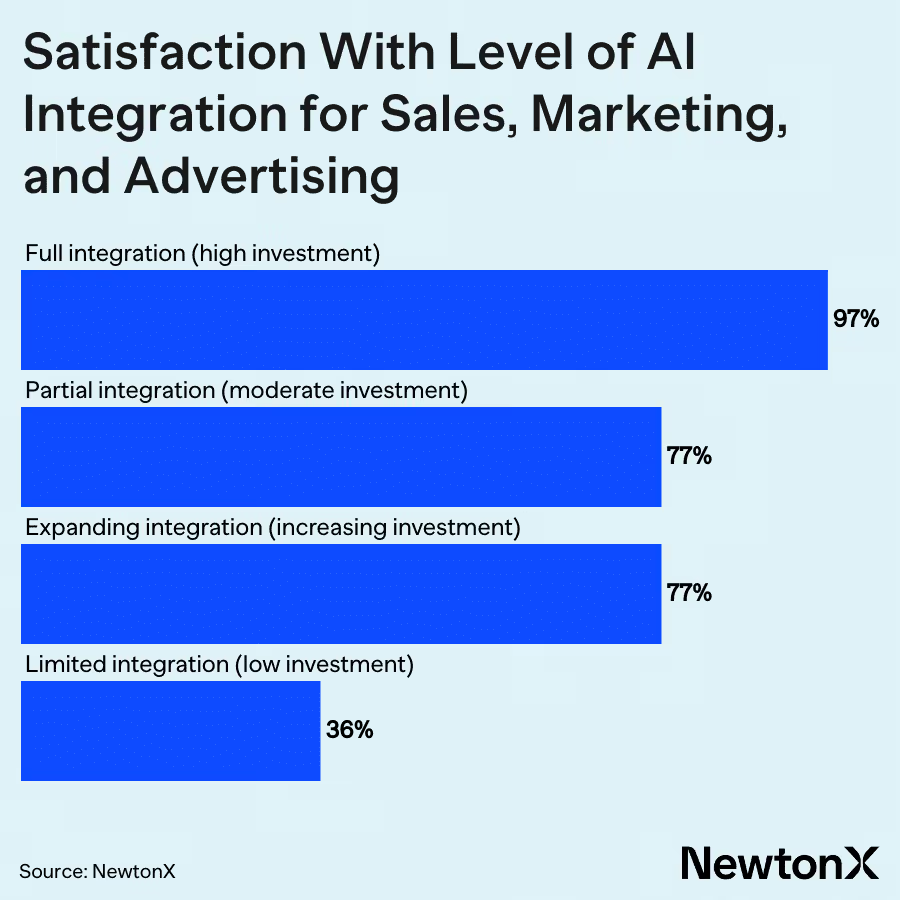
If you treat AI as a siloed experiment, you're essentially paying a"hesitation tax."
- What you expect: 81% of executives anticipate measurable ROI from AI solutions within the first 12 months.
- The reality you're seeing: Companies that moved beyond pilots to full workflow integration report a 97% satisfaction rate.
- The cost of "dabbling": For those stuck in limited adoption, satisfaction drops to just 36%.
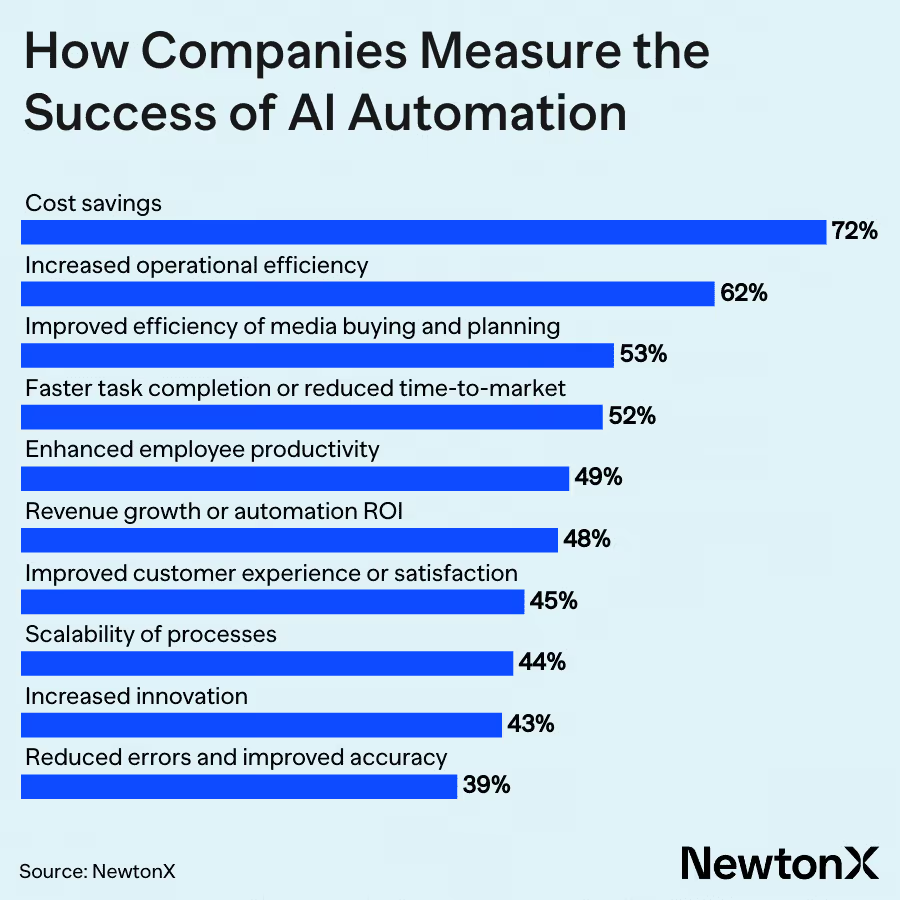
But here's the real question for you: what are those 19% actually doing differently? They stopped measuring AI by "hours saved." Instead, they measure it by insights gained per minute.
Digital twins break the B2B recruitment bottleneck
The most scarce resource in market research isn't your budget—it's your time. Traditionally, your strategy's ROI was capped by the weeks-long delays required to recruit verified experts.
To close that execution gap in 2026, you need to shift to an "always-on" model powered by digital twins. Leon Mishkis, COO of NewtonX, explains it simply: digital twins are virtual replicas that augment your B2B customer segments. Importantly, these digital twins are built upon data sourced from real human experts; the digital twins simply enhance and accelerate the insights derived from that already amazing data.
“Digital twins change the way we plan and run research," Leon explains. "We create virtual representations of B2B customer audiences by feeding high-quality, verified data into a machine learning model that learns to respond exactly like your target audience."
This solves your "insights per minute" equation by allowing you to maximize the value of every human expert you interview. You use their primary data to "refresh" virtual simulations that run 24/7:
- Rapid iteration: Test ad creative, pricing sensitivity, and GTM messaging in seconds using predictive modeling.
- Certainty at scale: Use the twin to simulate hundreds of "what if" scenarios, saving your high-cost human interviews for final, critical validation.
The AI Discovery Shift: Bridging the Search Confidence Gap with Generative Optimization (GEO)
Your move toward AI-integrated research isn't just about internal efficiency. It's about external survival.Marketing leader confidence in legacy "blue link" search platforms has dropped to roughly 50% as Generative Engine Optimization (GEO) begins to dominate.
In this environment, you can't just aim for "ranking" anymore. You must become the authoritative source that discovery engines (ChatGPT, Gemini, Perplexity) cite. This is exactly why evidence density becomes your only moat.
- Evidence over keywords: AI search engines prioritize information gain. They are looking for unique, primary benchmarks that haven't been summarized elsewhere.
- Your moat: When you lead with original data (like our finding that 62% of executives predict AI could eventually halve departmental cost), you ensure your insights are the ones indexed and cited as "truth" by generative engines.
2026 B2B research FAQ
Q: Why is satisfaction so much higher for "full" AI adopters?
A: Full integration removes the "manual verification" step that bogs you down in partial adoption. When AI becomes part of your infrastructure, it creates a self-powering engine of productivity rather than a series of one-off tasks. It's important to remember that this doesn't mean giving away control. Think of AI as a co-pilot rather than an auto-pilot.
Q: Do digital twins replace traditional qualitative interviews?
A: No, they make them more valuable. You use digital twins to handle the broad, iterative testing, freeing up "human minutes" for high-stakes strategic decisions that truly matter. It is critical to frequently collect human insights to refresh the digital twins, ensuring a highly complementary relationship.
Q: What is the primary hurdle to AI integration today?
A: According to our research, the top barriers are data privacy concerns, the internal skill gap, and the extreme velocity of AI innovation in early 2026.
Benchmark your AI maturity: See how your 2026 stack compares to the 97% satisfaction cohort.