







Key Takeaways
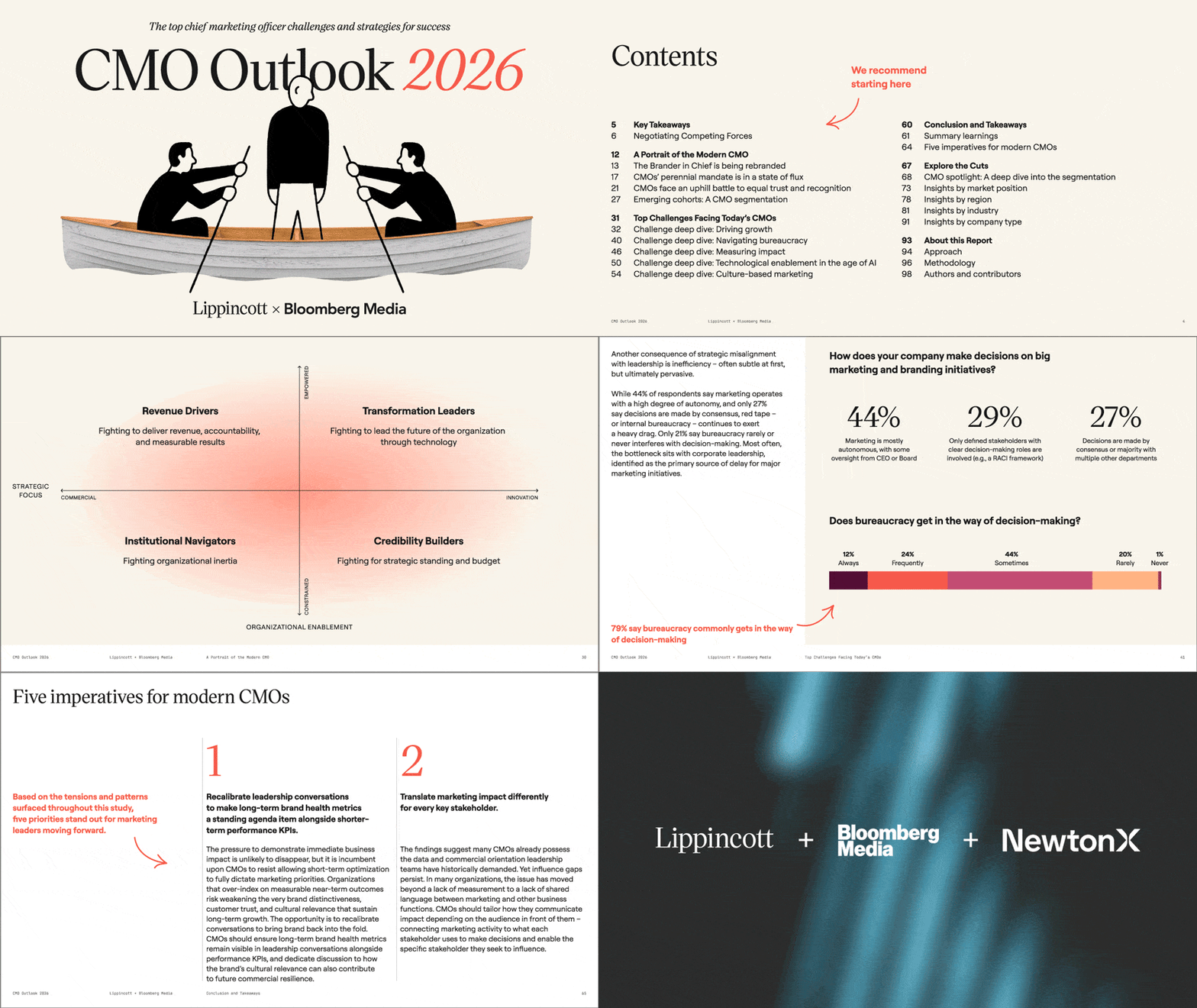
Understanding how CMOs see their own role is core to Lippincott’s work as a brand and marketing consultancy. But the research available to inform that work had a problem. Existing studies were either too narrow, one industry, one region, to mean much globally, or so broad they explained nothing about what was actually driving the role’s tension.
Lippincott and Bloomberg Media set out to build a more definitive read: one segmented by region, industry, market position, and company type, precise enough to show what averages hide. The two teams also worked out how the findings would eventually reach the market. NewtonX built and verified the resulting sample of CMO respondents across 30+ countries and 35+ industries.
What the data confirmed became the study’s central thesis: CMOs can see what the job requires. Their organizations make it hard to deliver.
NewtonX reached 541 CMOs and equivalent senior marketing leaders across 30+ countries and 35+ industries, confirming each one’s title and role before counting their answer. The findings trace back to verified roles, not an anonymous panel. That gave Lippincott and Bloomberg Media something title and industry alone couldn’t offer: a sample confirmed by seniority and function, precise enough to split by what a CMO actually controls.
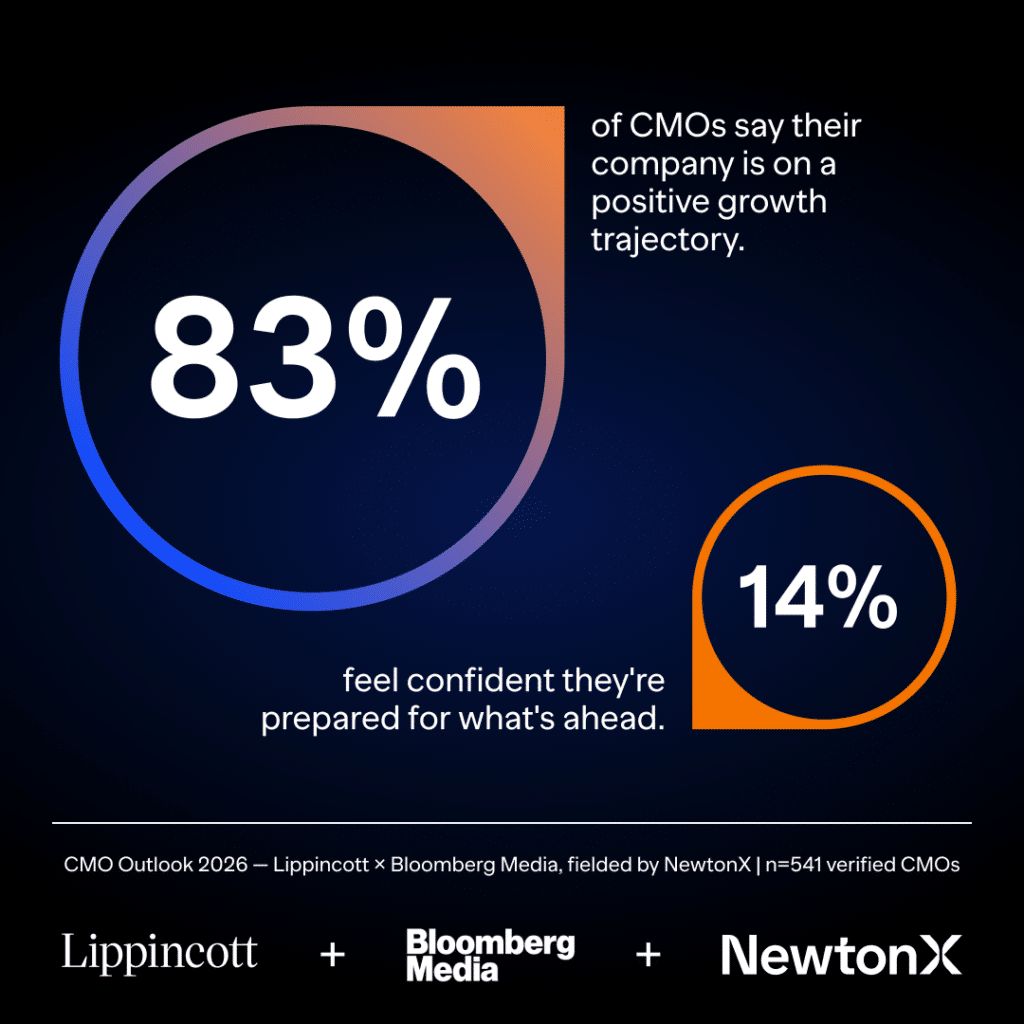
Eighty-three percent of CMOs call their growth trajectory positive. Only 14% are very confident their organization is ready for what’s next.
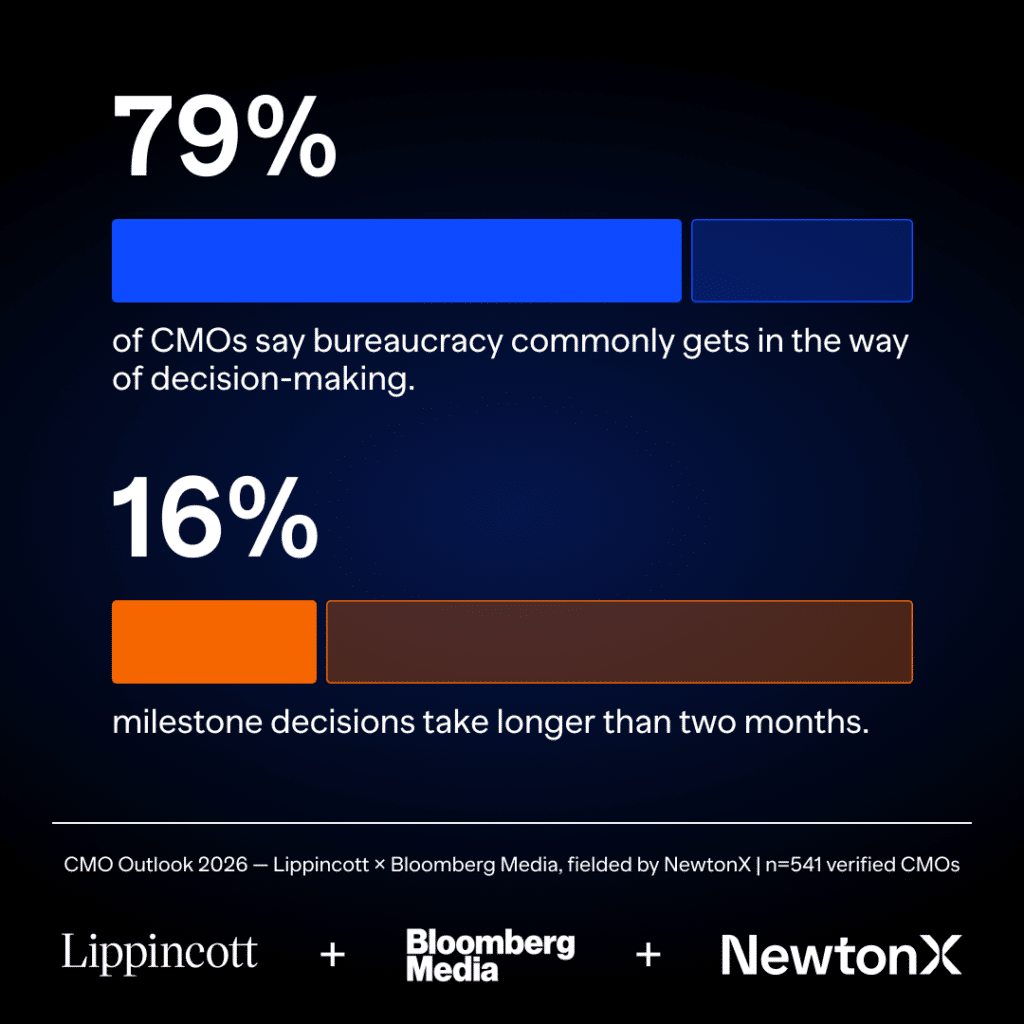
Organizational dynamics explain why. Seventy-nine percent say bureaucracy slows decisions down, more often blaming corporate leadership than weak data or fragmented tools. Less than half, 48%, feel marketing gets sufficient credit for its contribution to growth. Even culture shows the same pattern in miniature: 41% say they personally stay ahead of it while their own company lags behind.
The research suggests the next era of marketing requires a different mindset; CMOs need to recalibrate their relationships internally to advocate for long-term brand success alongside immediate performance.”
— Michael D’Esopo, CEO, Lippincott
The research didn’t stop at naming the barrier. Bloomberg Media’s team led the segmentation analysis in close collaboration with Lippincott, building a way to sort CMOs that title and industry never could. Rather than group by sector, they segmented marketing leaders by what they’re actually fighting for inside their own company: revenue drivers pushing for accountability and measurable results, transformation leaders pushing to lead through new technology, institutional navigators pushing against organizational inertia, and credibility builders pushing for strategic standing and the budget to back it.
Our research with Lippincott reveals that organizational alignment, more than any technological advancement or ROI alone, is often the defining factor in whether companies are truly prepared for the future.”
— Christine Cook, Global Chief Commercial Officer, Bloomberg Media
Business Insider broke the findings first, on June 17, under the headline CMOs are getting more responsibility — without power. The framing was blunt: CMOs are finally getting titles like CGO that reflect real growth responsibility, but the authority hasn’t followed.
Bloomberg Media followed with its own publication of the research, framing the findings around CMOs’ expanding responsibility for growth and AI-led transformation while organizational influence and support continue to lag behind those expectations.
Marketing Dive framed the study around AI-era tradeoffs, highlighting that many CMOs are increasing investment in AI while deprioritizing the brand and experience foundations that support long-term growth.
Six days after Business Insider broke the story, Bloomberg Media and Lippincott’s CMO Outlook 2026 moved from a published study to a live argument. They convened an invitation-only CMO lunch at Cannes Lions on June 23, chaired by Christine Cook, Global Chief Commercial Officer at Bloomberg Media, and Greg Handrick, Senior Partner and EMEA Managing Director at Lippincott, bringing senior marketing decision-makers attending the festival in to react to the data directly.
The conversation went past the obvious read. Short-term results have become most CMOs’ top priority, yet the highest-performing marketers in attendance said they stay anchored to long-term brand building anyway. AI and data dominate the industry conversation, attendees argued, but the real barriers are a lack of C-suite alignment and insufficient trust in marketing’s role. The CMOs who reported real influence credited a close relationship with the CEO and a bias toward alignment over new tools.
Campaign covered that lunch a week later across its US and UK editions, under the headline The growth barriers CMOs can’t solve alone, framing marketing performance as something no CMO can fix in isolation, and Handrick delivered the line that people repeated: “We don’t trade off the long term for the short term.”
The research kept surfacing weeks after launch. Fast Company cited CMO Outlook 2026 in an article on AI orchestration, calling it a clear distillation of the challenges CMOs face today.
In the first two weeks after publication, the campaign generated an estimated 62 million media impressions. Social posts on LinkedIn and X reached an estimated audience of 11.5 million. Traffic to Lippincott’s website rose 22% in new users over the same period.
CMOs aren’t confused about what growth requires. They’re stuck inside organizations that haven’t caught up to it.
Read the full report: CMO Outlook 2026 →
See how NewtonX powers research like this: Explore NewtonX thought leadership →

Put our framework to the test, and you’ll see firsthand how better data leads to better decisions. Try us for your next project and experience the benefits of having a true partner in data integrity.