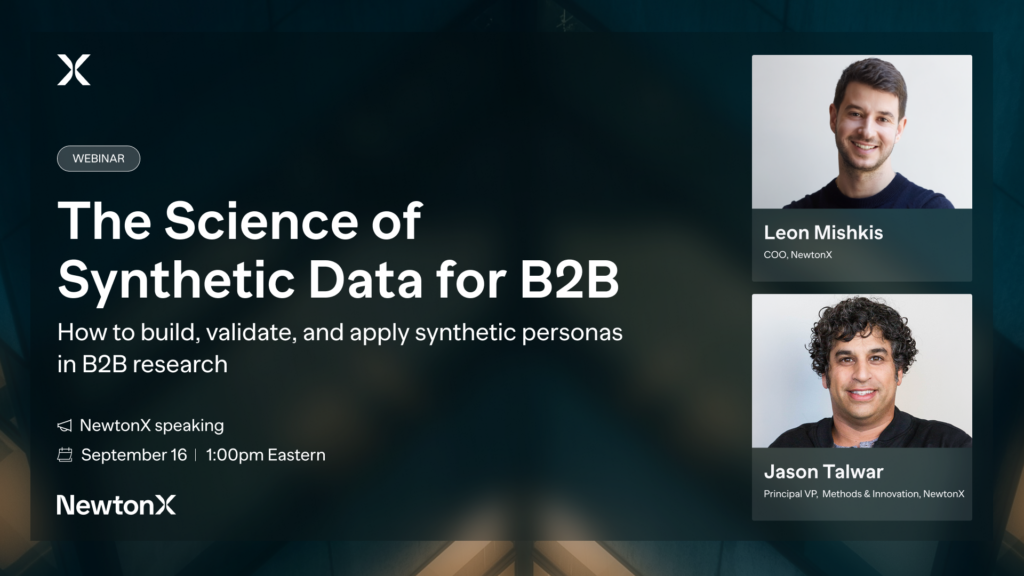
How to build, validate, and apply synthetic personas in B2B research
Synthetic data has moved past the demo stage. The harder question is what B2B teams can responsibly do with it.
NewtonX COO Leon Mishkis and Principal VP, Methods & Innovation Jason Talwar took a practical look at the science behind synthetic research. Their conclusion was clear: synthetic personas can make research more continuous, faster, and more efficient when teams build them on verified data, match them to the decision at hand, and validate their outputs with real people when the stakes require it.
Why B2B needs purpose-built personas
B2B buyers rarely publish the information that shapes their decisions. Their priorities, internal constraints, buying roles, and evaluation criteria sit inside organizations and buying groups. Public data can help describe an audience, but it rarely captures the professional context that makes B2B behavior meaningful.
That gap creates four common problems for teams building their own personas in a general-purpose model:
- Confirmation bias when stakeholders phrase questions to produce the answer they expect
- Lack of guardrails when the model responds confidently outside its evidence base
- A tendency to flatten different behaviors into an average response
- Limited perspective when the model only draws from a company’s internal data
NewtonX’s approach starts with a behavioral shell built from research on thousands of B2B buyers. The shell captures eight behavioral dimensions, including innovation orientation and information sourcing, to help explain why different buyers respond differently to the same message or concept.
The shell then connects to broader syndicated research and client-owned data. The result is a persona designed around a specific audience and research context, with a foundation that can evolve as new primary research comes in.
Synthetic personas and primary research strengthen each other
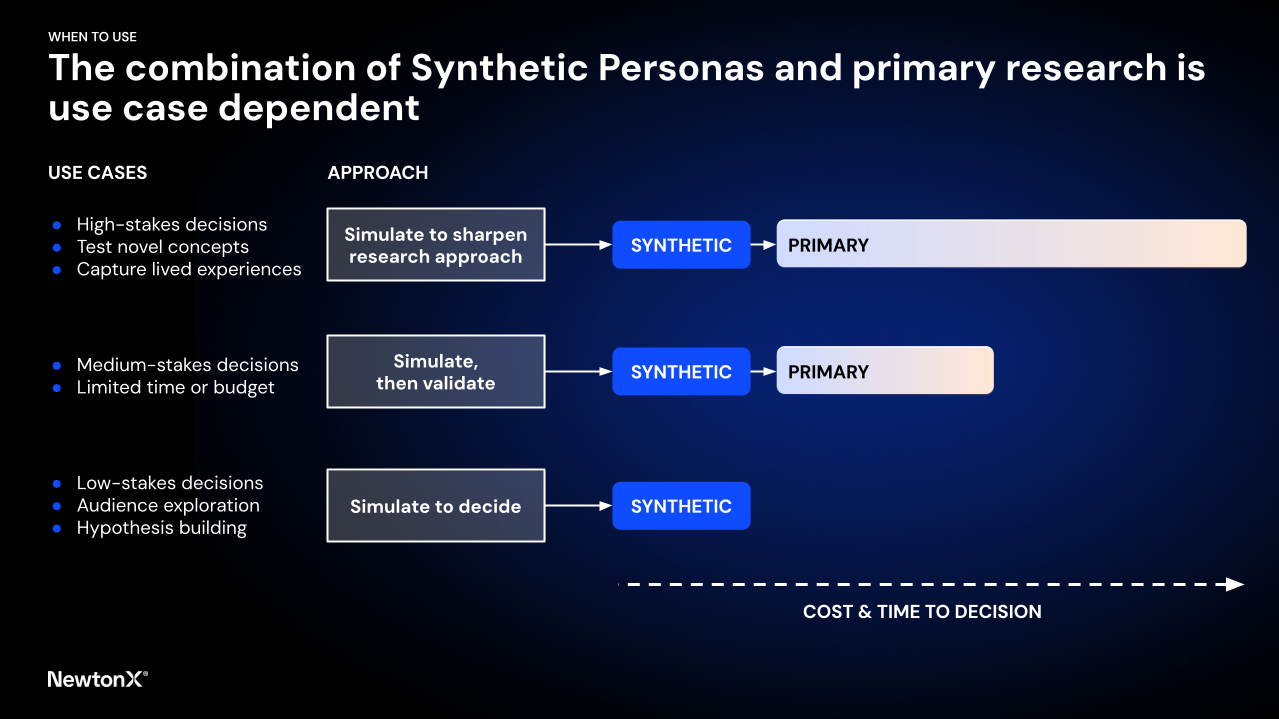
The webinar drew a clear line between simulation and evidence. Synthetic personas can sharpen a research plan, surface hypotheses, and answer lower-stakes questions quickly. Primary research remains essential when a decision needs statistical defensibility, involves a fundamentally novel concept, or depends on a lived experience the persona could not have encountered.
Leon described three practical levels of use:
- For high-stakes decisions, use simulation to refine the research approach, then run full human research.
- For medium-stakes decisions, simulate first and validate the most important findings with a lightweight survey or interview program.
- For lower-stakes decisions, use simulation to test hypotheses and decide whether a larger study deserves attention.
The workflow can stay simple: select a core or custom persona, run a simulated study or chat-based exploration, then add human validation when the decision calls for it. The higher the stakes, the more validation the work needs.
The right reliability test is decision equivalence
.png)
Synthetic research does not need to reproduce every distribution or point estimate to create value. For the use cases NewtonX has tested, the more useful question is whether real respondents and synthetic personas reach the same decision.
That means comparing which message wins, which concept ranks highest, or which price point earns the strongest response. It means focusing on directional differences and rankings rather than presenting synthetic outputs as causal proof or exact population estimates.
Across NewtonX testing in message, concept, pricing, and brand studies, synthetic personas have reached an average of roughly 92% decision equivalence with real respondents. The figure describes agreement on the decision the research supports. It does not turn a simulated result into a substitute for full primary research.
The session also showed why every new primary study can become an A/B test. Teams can compare a synthetic prediction with fresh human responses, learn where the persona performs well, and use the new data to strengthen future simulations.
Where B2B behavioral modeling is headed
.png)
The current generation of synthetic research predicts how a persona might respond to a survey question. The next generation will model more of the behavior around the decision.
Jason outlined three areas to watch:
- Event prediction, such as estimating how a market shock, competitor move, or product launch might affect an audience
- Buying-group simulation, including how influence, objections, and consensus play out across multiple stakeholders
- Ad and visual stimulus prediction, where computer vision and response models could help estimate attention and action
Each capability will require more data and more testing. The direction is clear: synthetic research will help teams identify signals earlier, decide where to invest in primary research, and keep customer understanding active between formal studies.
Three principles to take forward
- Start with the data. Synthetic outputs inherit the quality of the research underneath them. Verified respondents and strong source data create a foundation teams can inspect and defend.
- Match the method to the decision. Use synthetic personas for the questions they can answer well, and bring in human research when the concept, stakes, or evidence requirements demand it.
- Validate before you scale. Use A/B tests and decision equivalence to build trust, then keep refreshing the persona as the market and the audience change.
The most useful synthetic research will not make primary research disappear. It will help teams reserve human fieldwork for the questions that need it most, while giving decision-makers a faster way to explore everything around those questions.