



How NewtonX brings self-serve B2B recruitment and AI-moderated research into Hub
By Michael Maloof, VP and Head of Marketing
Contributors
- Interviewee: Leon Mishkis, Chief Operating Officer at NewtonX, worked on the end-to-end development of the self-serve AI-moderated research workflow in Hub, connecting client needs with audience feasibility, B2B recruitment, platform workflows, and early beta testing.
- Interviewee: Hannah Wang, Associate Manager on NewtonX’s Strategic Insights team, led AI-moderated research interview guide design and reporting for NewtonX’s co-branded Coinbase case study, presented at TMRE 2025, delivering FinTech purchasing insights in three weeks.
- Interviewer: Michael Maloof, VP and Head of Marketing at NewtonX, leads positioning, go-to-market, and communications for recent market research product launches, including Hub, Synthetic Personas, and AI-moderated research.
Introduction
In my conversations with B2B clients, the hardest part of the research process often comes before the first question: finding professionals with the authority, experience, and time to give a useful answer.
AI-moderated research addresses part of that problem by pairing structured questions with adaptive follow-ups. NewtonX built the pieces behind that process: NewtonX Graph helps find and verify specialized professionals, and Hub lets teams check audience feasibility and launch AI-moderated research, all from the same place."
The goal is to move faster without losing track of who answered, how they were recruited, or how the findings support a decision.
That gives a team a shorter path from a research question to qualified respondents and usable findings, with fewer handoffs. I sat down with Leon Mishkis, NewtonX’s Chief Operating Officer, and Hannah Wang, Associate Manager on NewtonX’s Strategic Insights team, to discuss how they built AI-moderated research with B2B clients in mind.
AI-moderated research, in practical terms
What is AI-moderated research?
AI-moderated research pairs structured questions with adaptive follow-ups, so teams can collect both direct answers and the reasoning behind them. In Hub, teams can define an audience, check feasibility, launch recruitment, and review findings from the same place.
The approach is already being used for time-sensitive B2B work. In a Brand Finance case study, NewtonX recruited more than 200 IT decision-makers and completed five in-depth investor interviews in three days for a brand perception study.
Why B2B research is hard to start
What usually gets in the way when a B2B team needs to start research, and why did this make a self-serve workflow worth building?
Leon Mishkis: "B2B audiences are highly complex and require a lot of criteria, and it takes time to find them. That’s why nobody has cracked self-serve B2B research with all of these screener criteria and audience nuances. If a client wants to start self-serve AI-moderated research, they have to reach out to the platform, reach out to recruiters, and coordinate around the right audience with a ton of stakeholders involved."
"Given that we have both the platform and the recruitment capabilities, we were able to automate the workflow and enable clients to work fully self-serve: finding the right experts, running the research, and getting the analysis and insights without going back and forth with account managers."
The respondent determines the quality of the answer
Why is finding the right professional respondent so important in B2B research?
Hannah Wang: "In B2B research, especially when clients have complex workflows, jobs to be done, and decision-making processes, it’s really important to find someone who can speak intelligently about the product or service we’re evaluating. Oftentimes, that requires a complex chain of screening questions."
"What’s really important is being able to identify the right people who have a solid mix of expertise. If we’re looking for authority, we need someone with decision-making authority. Or we may be looking for someone who works with the tool we’re discussing day to day."
Where an AI moderator adds value
What can an AI moderator do that a static questionnaire cannot?
Hannah Wang: "The most valuable part of AI-moderated research is the ability to ask why. What AI-moderated research can do that qualitative research alone cannot is produce actual counts. We can ask close-ended, multiple-choice questions."
"With an AI-moderated research interview, we can ask a perfectly reproducible quantitative question. Then AI-moderated research can get to the why and add more color and context to what the respondent selected."
"AI-moderated research is really strong when you don’t know what you don’t know."
What changes inside Hub
What can customers now do directly in Hub, and how does that change the experience of starting research in general?
Leon Mishkis: "Hub was always a great tool to analyze and visualize quantitative and qualitative research, cut down 90% of analysis and reporting time, and democratize access to data. The one missing piece was starting expert recruitment with highly specific B2B recruitment criteria, which we’ve now added to the platform."
"You can trigger a recruitment request, give us the exact audience, and our quoting automation tool returns feasibility. You can kick-start recruitment and see AI-moderated research insights come in almost live, giving you an always-on engine with recruitment and analysis all in one."
"Our technology can return the exact feasibility of a niche B2B audience in a few seconds, so clients can move from “I have a need” to launching a project with a clear understanding of feasibility and cost within minutes rather than hours or days."
Easier to start, harder to misuse
How do we make research easier to start without sacrificing quality and accuracy?
Hannah Wang: "The best thing clients can do is provide clear research objectives and share how those objectives ladder up to their business goals."
"General research tends to sit on the shelf unless it’s tied to a specific business objective. The last thing I want to do as a researcher is provide a whole report about how HR people make decisions about retirement plans and then have you do nothing with it."
"You really want to think about how those research objectives will be used. Then, after you have that information, we can start crafting a questionnaire that accomplishes those goals directly."
Where Synthetic Personas fit
What’s the benefit of having AI-moderated research alongside Synthetic Personas in Hub?
Synthetic Personas give teams a way to test messages, pricing, and concepts with a defined B2B segment between research studies.
Leon Mishkis: "We really believe the future of research is what we call simulation and validation. We recently launched our Synthetic Personas offering, which allows you to simulate potential buyers’ responses to messages, pricing, and competitive behavior, similar to large-scale research projects."
"But for higher-stakes research, in addition to synthetic simulation, many of our clients want to add a human validation layer. We’re the only platform that allows you to immediately trigger human validation with the exact same expert profiles underlying the Synthetic Personas."
"The higher-stakes the decision, the more human validation is useful. For some fast, quick-turn research, purely synthetic research might be enough to get a good directional answer."
What NewtonX refuses to compromise on
What was important to maintain when building this?
Leon Mishkis: "The most important element underlying the credibility of any research is making sure that the quality of the experts we recruit is of the highest possible standard. That was always what NewtonX stood for, and we would not compromise on the criteria or verification of B2B professionals."
"It’s important to maintain expert quality and nuanced criteria. Our clients come to us for niche B2B professionals. We wouldn’t want to launch a product that allows self-serve recruitment only for very simple B2B profiles, which is what some other providers have launched."
From simulation to continuous insights
What makes this different from other moderated research providers?
Leon Mishkis: "Nobody else has the B2B recruitment capabilities. Either people have the platform or they do recruitment. Nobody can do both."
"So it’s all about recruitment, synthetic simulation, and validation. That’s a continuous insight cycle, as synthetic and human research strengthen each other over time, all in one platform."
The practical takeaway
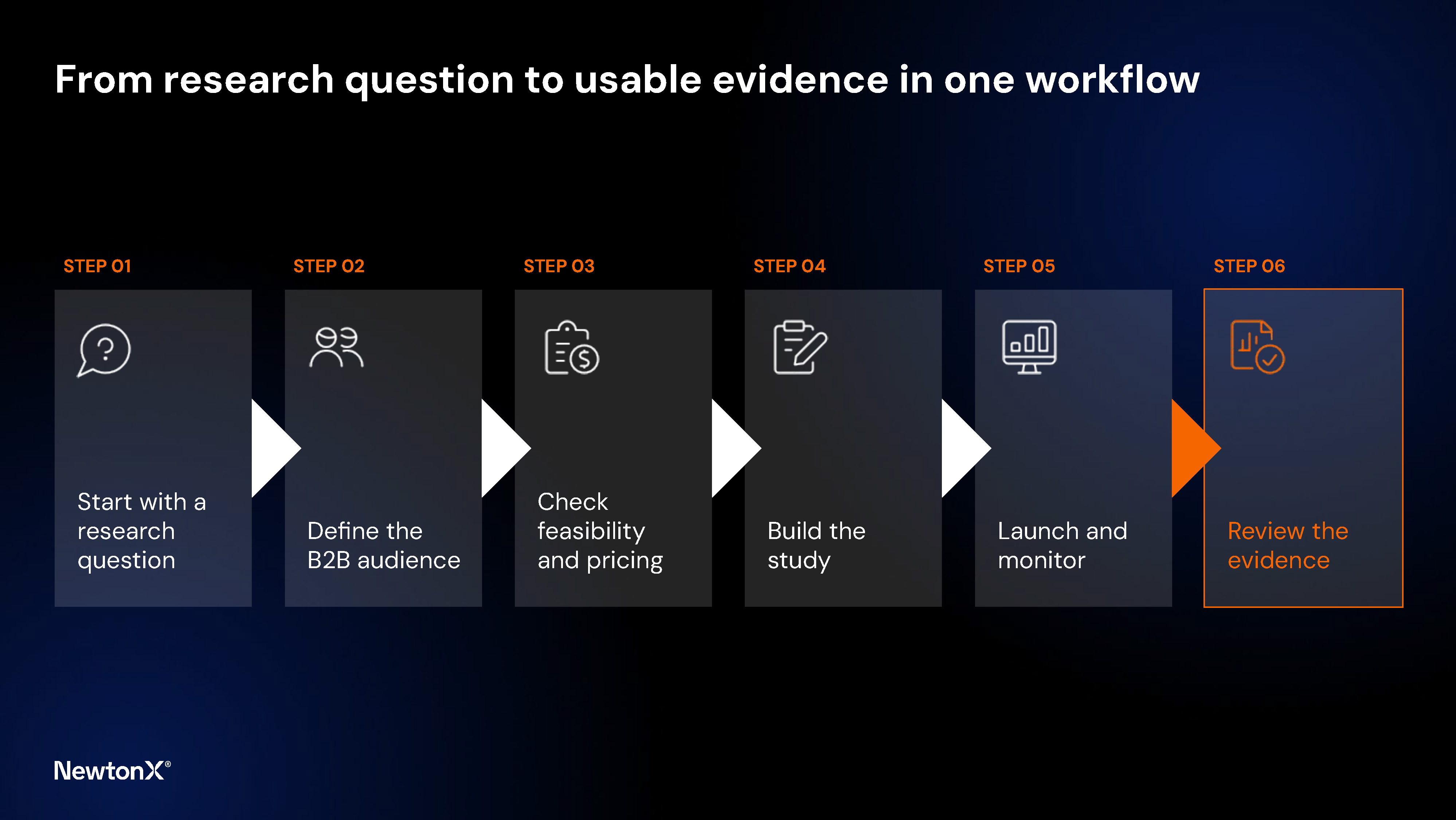
AI-moderated research does not remove the hard parts of B2B research. It puts them in a more workable sequence: define the audience, check feasibility, recruit qualified professionals, run adaptive interviews, and review the evidence. The result is a shorter path from a business question to a decision-ready answer, without treating respondent quality or human judgment as optional.
Next step: Talk with NewtonX about AI-moderated research in Hub.
Interview quotes have been lightly edited for clarity and readability.