



How NewtonX uses verified professional data to help teams test ideas, narrow hypotheses, and focus human research
By Michael Maloof, VP and Head of Marketing
Contributors
- Interviewee: Jason Talwar, VP, Methods & Innovation at NewtonX, brings the research and validation perspective to Synthetic Personas, including B2B behavioral modeling, decision quality, use case boundaries, and how synthetic results should inform human research.
- Interviewee: Jeremy Wood, Chief Product & Technology Officer at NewtonX, brings the technical and trust perspective, including model architecture, fact-checking, traceability, guardrails, and the product tradeoffs behind making Synthetic Personas useful in practice.
- Interviewee: Darshen Patel, Principal, Product Manager - Hub at NewtonX, brings the product and Hub perspective, including the user workflow, stable reusable personas, self-serve access, and the path from directional learning to human research.
- Interviewer: Michael Maloof, VP and Head of Marketing at NewtonX, shapes the company’s positioning, GTM strategy, and executive storytelling for B2B research and AI Data Services.
Introduction
I am constantly looking for a way to run an idea by someone quickly, get a temperature check, or ask an expert. As a marketer, I also balance that instinct with real budget and time constraints. This is where Synthetic Personas come in.
Built to support higher-stakes B2B decisions, NewtonX Synthetic Personas turn weeks of fact-finding into minutes of conversation. But instead of chatting with a hastily trained consumer AI bot, you are talking to a persona built on years of professional data and tailored to your use case. Want to test ten campaign messages with CMOs in your industry? Decide how to segment your next research project based on SVPs across ten geographies? Synthetic Personas are the answer to all of it.
Earlier this year, we launched Synthetic Personas at Cannes Lions 2026, introducing a way for B2B teams to keep the buyer in the room between formal research studies.
I sat down with the team behind NewtonX Synthetic Personas to discuss how they built it and, most importantly, why B2B business decisions require a different standard than general-purpose consumer AI can provide.
What are NewtonX Synthetic Personas?
NewtonX Synthetic Personas are AI-powered simulations of B2B audiences built from NewtonX’s identity-verified professional data and client research. In NewtonX Hub, teams can ask questions, test messages, and narrow options before deciding where human research is needed.
Synthetic Personas at a glance:
- What they are: AI-powered simulations of B2B audiences grounded in verified professional data.
- What they’re good for: Lots of things. We’re always finding new use cases but have validated them for message testing, concept testing, directional pricing, and narrowing research options before investing in a larger study.
- What they’re not: A replacement for high-stakes primary research, precise measurement, or recent event coverage.
Why B2B teams need a different kind of synthetic research
Why are B2B audiences harder to understand and simulate than broad consumer audiences?
Jason Talwar: “The number one reason is visibility across the entire customer journey. When we think about B2C and the customer journey, we can follow them from end to end. We can survey them, track them, see what they purchase, and get their behavior. There are more of them, too.”
“When you get to B2B, there’s a lot of complexity. How do organizations make decisions about what brands to bring into the organization? It’s no longer an individual problem. In B2B, multiple people are involved, and each one has to be tracked. It’s also really hard to get enough samples to produce a good training set. We have a blind spot; we don’t have the same visibility as B2C , and we have to get answers to it.”
What problem were we trying to solve in the research process?
Darshen Patel: “The clearest version of the problem showed up as a workaround. Researchers who wanted to talk to a persona were forcing Isaac, the proprietary AI market research assistant in our Hub platform, into the role: an analytical agent asked to play a buyer. It couldn’t really do it.”
“Hub Researcher was scoped to a single study, so every question you asked was bounded by whatever that one study happened to cover. Asking an analytical tool for a qualitative read on how a security buyer thinks about a vendor decision was asking it for something it wasn’t built to give.”
“Teams often cannot afford the time, budget, or researcher bandwidth to run primary research for every question, creative, or iteration, so many directional decisions were made on instinct. Synthetic research is intended as a fast pre-test and hypothesis filter, not a replacement for high-stakes human research.”
What makes NewtonX Synthetic Personas different
What data and architecture form the foundation of a Synthetic Persona?
Jason Talwar: With synthetic personas, like any AI model, the input really dictates the output, you can't build something solid on weak data. That's why every part of our training set is built on verified survey responses, we know who took the survey, in addition quality checks embedded every step of the way. Rather than treating data as a separate step, those inputs directly inform and power our models. This gives us confidence with building our synthetic personas.
“In terms of the architecture, The core of every synthetic personas is an I intensive B2B behavioral segmentation. We built these by talking to thousands of B2B professionals to understand how they think, act, and behave professionally and in buying situations.”
“One dimension, for example, is openness to innovation. Someone willing to take risks may gravitate toward a message about a new AI solution in beta. Someone who needs evidence and case studies may reject the same message, not because the message is unclear, but because it does not fit how they evaluate decisions.”
“We then connect these ‘behavioral shells’ to our own data, including market measures such as brand affinity, switchability, and consideration. The other important aspect is the client’s own data, which adds an additional layer of training to customize personas aligned to their ICP's or target segments.”
Why isn't a general-purpose AI model enough, and how do we build trust?
Jeremy Wood: “A general-purpose AI is a very smart, short-term-memory-focused problem solver. It’s great at solving problems, but it’s not good at operating in a world it doesn’t know anything about. That’s often the situation in B2B, where you’re talking about niche issues, and fewer people understand what a good answer is, much less the facts that go into generating one.”
“If you dump your data into Claude, it will be able to analyze it. But it won’t automatically pull in additional context or know what the current state of the world is around that issue. It won’t give you point-by-point traceability of your facts, while making informed logical leaps that you can see. A Synthetic Persona can be specific not just in the knowledge it has, but in how it thinks about that knowledge and approaches a problem. We can do things with the underlying LLMs, or in many cases swarms of LLMs, that you just can’t even approximate with raw foundational models.”
What the experience changes for researchers and marketers
How does Hub make the process easier without removing the rigor?
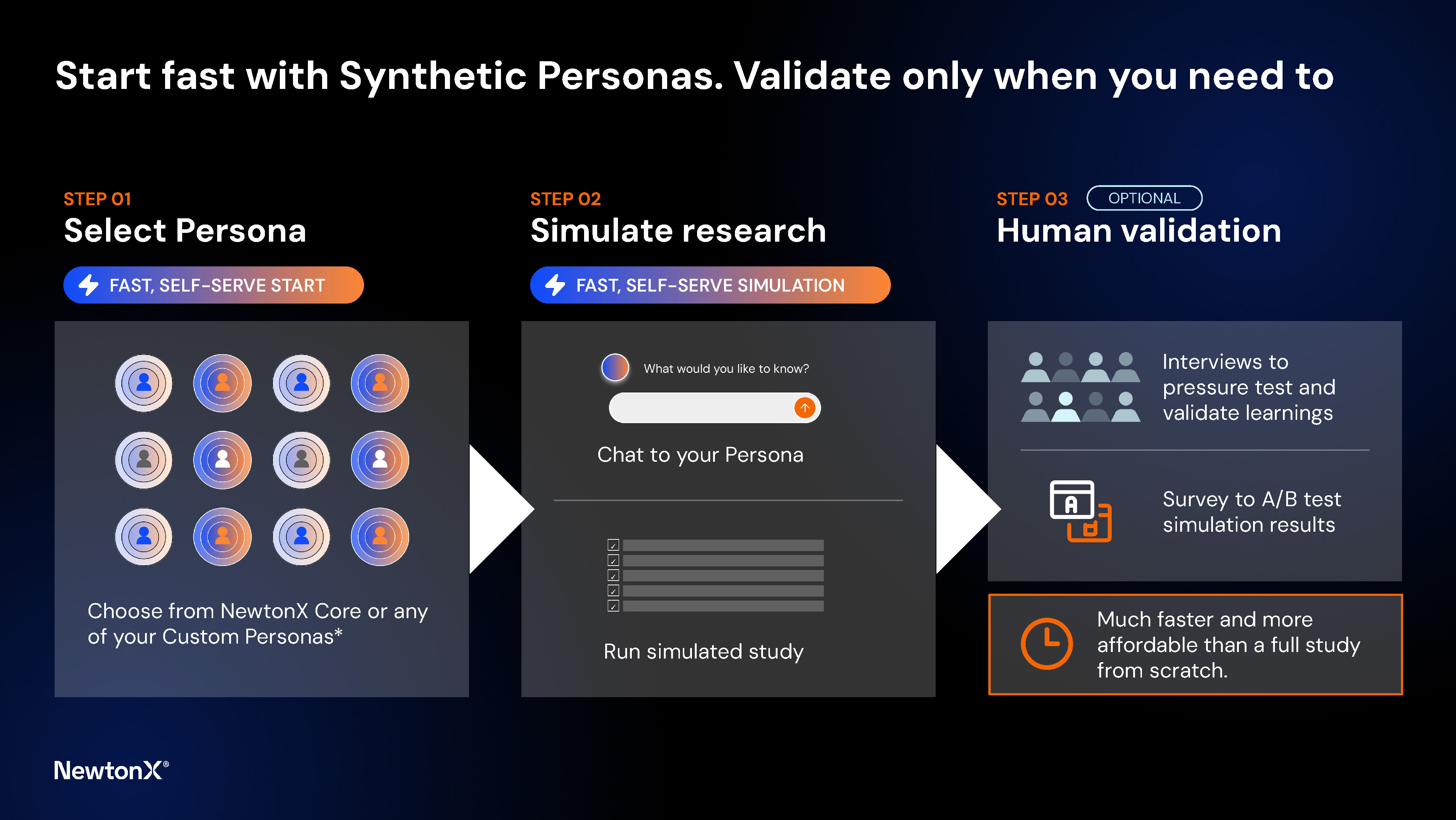
Darshen Patel: “The easy part is that there’s nothing to set up. A user lands on the homepage or the persona library, picks one of the nine personas we’re launching with, and starts talking. No study to configure, nothing to field, no four-week wait.”
“The rigor is in how we separate two things that people usually collapse into one. The persona is reusable and stable. The study holds the configuration and the output. So testing a message never changes the persona you tested it with.”
“You can come back next month, run the same persona, and compare against what you got before. If every conversation quietly reshaped the persona, you’d have a chat interface with no baseline, and you couldn’t tell a real shift in the market from drift in your own tool.”
What can Synthetic Personas answer, and what can’t they answer?
Jason Talwar: “We’re still learning what Synthetic Personas are best suited to answer, but the boundaries are becoming clearer. They can be useful for perceptions, message saliency, conceptual testing when the concept is grounded in something people can understand, and directional pricing sensitivity.”
“They can tell you whether an audience is likely to pay more, the same, or less. They cannot necessarily tell you the exact dollar amount. They are not good at lived-experience questions, such as asking someone to recall how they felt at a specific conference. The synthetic persona was not there, so it does not have that experience to draw on.”
What the team learned while building it
What was the hardest technical or product decision to get right?
Jeremy Wood: “The hardest decisions are questions of balance. One is how much compute and runtime to use to get the best possible answer within a response time that still feels reasonable to a user. In an ideal world, I would let the model think like Plato for five days before responding. That’s obviously not realistic.”
“The other balance is deciding how much to build to make this meaningfully better than simply putting the data into Claude. The product decision is deciding what to tackle first to create the most value for customers, and what to put off until later because it is a smaller but still important step toward being best in class.”
What are you most proud of, and what should this change about B2B decision-making?
Darshen Patel: “What I’m most proud of is that a researcher can now start this on their own. They pick a persona, ask it questions, and if the conversation is useful,l there’s a path from there to Real Validated Research, a Custom Persona, or a simulated study. Before, that first step needed someone else’s calendar.”
Jason Talwar: “I think about this as decision equivalence. If dataset A is real and dataset B is synthetic, the question is whether they lead us to the same business decision.”
“That does not mean pretending synthetic results are statistically significant in the same way as real research. Instead, we can say the results are materially different, directionally different, or show no meaningful difference. The practical value is efficiency. If a team has 100 messages, Synthetic Personas can help narrow them to five worth testing.”
“Synthetic research helps focus the research stack rather than replacing it. If a decision needs to be made quickly, synthetic research can provide data-backed direction when a four-week study would arrive after the decision has already been made. When the decision requires precise measurement, original research remains the right next step.”
Conclusion
B2B teams, like mine, have historically had to weigh rigor against speed when making market research decisions. NewtonX Synthetic Personas now give us a way to get fast, cost-effective answers before, between, and after primary research. So run your next big decision past a synthetic CMO, doctor, or strategist before you spend big on your next project.
Next step: Talk to NewtonX about Synthetic Personas
Interview quotes have been lightly edited for clarity and readability.