















![[Webinar Recap] Is B2B ready for synthetic sample? Yes – if you know how to augment it](https://www.newtonx.com/wp-content/uploads/2024/10/Webinar-synthetic-sample-greenbook-1024-1920px-feature-image-1-300x169.jpg)
![[Webinar Recap] The future of B2B research starts with the death of panels](https://www.newtonx.com/wp-content/uploads/2024/07/TKH-8.22-Karine-Pepin-webinar-1920px-feature-image-300x169.jpg)
![[Webinar Recap] Ditch the Bad Data with Greenbook’s Lenny Murphy as Your Guide](https://www.newtonx.com/wp-content/uploads/2024/05/tkh-greenbook-newtonx-lenny-murphy-cutting-research-cost-speakers-v-21920px-feature-image-300x169.jpg)
How to avoid the B2B synthetic data trap

The market is making bold claims about synthetic data, but the research tells a more complicated story. We’re here to guide you through that gap.
When your budget says yes, but your research has to answer for it.
The VP of Marketing just issued a directive: The team needs to use synthetic data. No use case attached, no methodology specified. But it’s a mandate, and the insights team is responsible for making it happen.
Down the hall, the company’s research VP counterpart wonders what happens when leadership asks her to defend the methodology in front of the board. They might pepper her with questions like, “How was this data derived? How do you know those answers aren’t made up?” Because behind every research deliverable is a person whose career and reputation are staked on the findings.
The marketer sees opportunity. The researcher sees exposure.
At a conference earlier this year, a senior research executive in the entertainment industry was asked to assess the quality of synthetic data in B2B. Her answer? “Not terrible.”
The technology exists. Some of it works. Almost none of it in the way that the marketing copy implies.
First, synthetic data is an output. It’s a simulation with artificially generated data designed to replicate the structure and statistical properties of real-world responses. It offers a solution when budgets are limited, data is needed quickly, or niche quotas limit feasibility. The methodology that generates it (and the data it was trained on) determine whether the output is intelligence or noise.
“Synthetic data” covers at least four distinct capabilities treated interchangeably by much of the market. Before you evaluate a vendor, you need to know which one you’re buying.
Four things by the same name
The market labels four fundamentally different capabilities the same way. Each requires a different data foundation, carries different limitations, and serves different decisions. Conflating them is where bad procurement starts; the data requirements, the outputs, and the risk profiles are different for each.
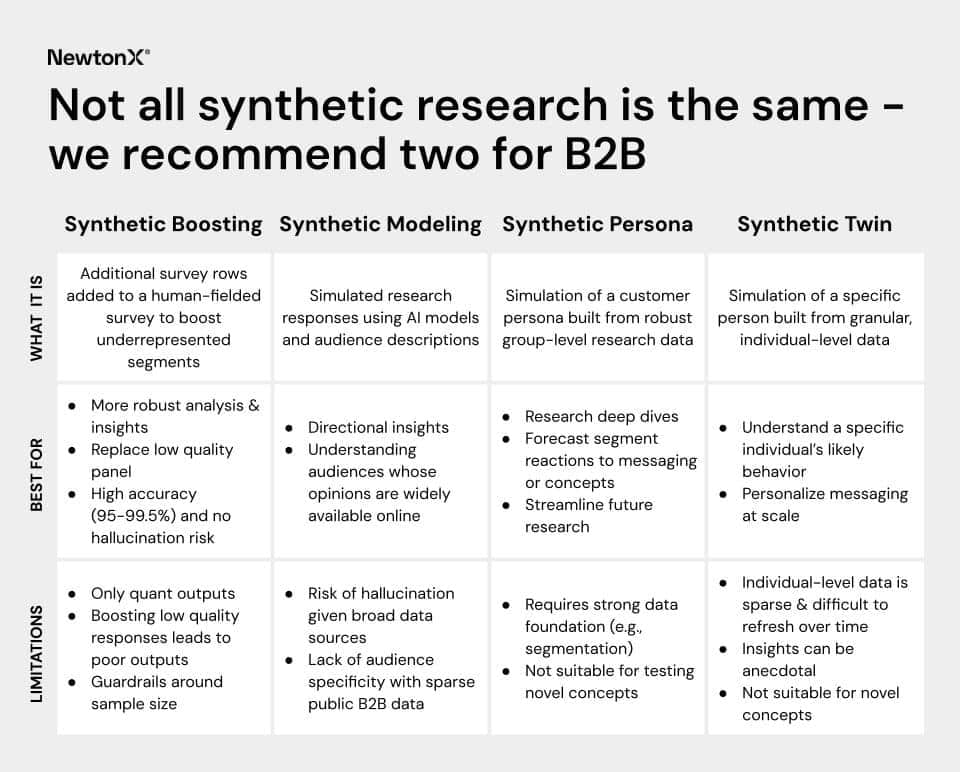
- Synthetic boosting adds new rows to a real dataset using patterns learned across all segments to generate additional responses for underrepresented groups.
- Synthetic personas simulate an audience from scratch based on verified data, and are queryable anytime without running a new study.
- Synthetic modeling generates simulated responses using AI models and audience descriptions, sometimes drawing on survey data, sometimes on publicly available market data and LLM outputs. But without a verified respondent foundation, outputs are directional at best and can’t replicate the specificity that B2B decisions require.
- Synthetic twins, built from granular individual-level behavioral data, face a different constraint: B2B data is sparse, hard to verify, and difficult to keep current. So while the output can look rigorous, the actual foundation behind it rarely is.
That brings us to the one variable that determines whether you get intelligence or noise, regardless of solution type: the quality of the data underneath. We call this The Data Inheritance Problem. The origin of the training data (who the real humans were, how they were verified, what expertise they brought, and how the model was constructed on top of that foundation) separates synthetic research from synthetic guesswork.
Most vendors aren’t volunteering those details. And most buyers aren’t asking.
What the evidence shows
B2B International took its Superpowers Index of 3,000-plus global B2B decision-makers, handed two-thirds of the data to a synthetic provider, and asked them to simulate the rest. Overall accuracy came back at 86%. Promising, right?
Then they cut by seniority, company size, and business type. The synthetic data flattened everything, masking the subgroup differences that B2B research exists to find. For longitudinal prediction, or, in other words, simulating what the next wave of data would show, synthetic outputs aligned with actual trends 42% of the time. Worse than a coin flip. Their verdict: A smaller real dataset beats an augmented fake one.
But that study didn’t name the provider tested, so we don’t know whether this was a foundation problem, a methodology problem, or both. It could have even been fully generative synthetic, AI-generated responses with no real survey data underneath, rather than boosting existing research.
Regardless, we know one thing: It failed in a way that B2B research can’t afford.
The product is the source
NewtonX’s A/B test across three independent sample sources found synthetic boosting trained on verified professionals achieved 95–99.5% equivalence with a custom-recruited human control. Unverified panel sample diverged 20–40% from the same control, before any synthetic method touched it.
The boosting technology itself achieves high equivalence regardless of input; that’s the catch. In other words, train it on verified professionals, and you get verified-quality output. Train it on unverified panel data, and it’ll faithfully reproduce that data with fraud, inattention, and other flaws included. Garbage in, garbage out.
Unverified data has always been a problem in research, but the consequences scale exponentially with AI. When bad data feeds an AI system that compounds decisions at scale, the errors compound with it. You can’t predict the future from faulty data about the past. And when no one is feeding fresh, verified data into these systems, the quality degrades in ways that are much harder to detect and correct than a bad survey ever was.
Why B2B breaks the consumer model
Consumer populations are large, observable, and relatively homogeneous. B2B populations are small, context-dependent, and professionally specific in ways public data can’t capture. Nobody tweets about how their organization evaluates cloud security vendors. Nobody posts their procurement criteria on Facebook. The data that makes a synthetic B2B professional credible comes from years of structured, verified conversations with real professionals in real roles.
Published methodology research sets the minimum for reliable synthetic boosting at 300–500 real cases before modeling error falls below sampling error. But reaching 300 verified senior decision-makers in a specific role at specific company sizes is often the entire challenge.
If a vendor offers access to enterprise directors—professionals earning $300K–$400K in total comp—for $25 per survey response, ask what’s actually happening. Verified professionals at that level don’t take a 20-minute survey for $25. Synthetic data trained on respondents who aren’t who they claim to be inherits the fraud.
Four questions to ask your synthetic data provider
These questions synthesize validation requirements that have emerged from industry analyst guidance, published synthetic data methodology research, and our own experience. A credible partner should have a clear answer for each. The absence of one tells you just as much.
1. How did you build this? Can you show me the methodology?
What to listen for: Specific, documentable answers about who the real humans behind the synthetic data are, how they were verified, and how their expertise was confirmed for this study type. For larger engagements, a credible provider should be able to connect you with some of the underlying professionals directly.
Red flag: Any version of “trust us.” We source the highest quality data, we can’t tell you exactly who these people are, but take our reputation for it. That’s not transparency. That’s a black box. If a provider can’t tell you who their professionals are, they’re also not positioned to catch it when the model fabricates patterns those professionals would never actually produce.
How NewtonX answers it:
NewtonX builds synthetic personas through a custom needs, attitudes, and behaviors segmentation study designed around how each client views their customers and the market. Generic off-the-shelf personas tell you how some version of your buyer thinks. A custom-built persona reflects your segmentation, your language, and your competitive context.
Every professional in the network is identity-verified against corporate email and LinkedIn, and screened for expertise relevant to the specific study. For larger engagements, clients can speak with underlying professionals directly. Sourcing is documentable at every step.
2. How should I use this synthetic data in the context of my broader research?
What to listen for: A specific use case mapping where synthetic works, where it doesn’t, and how it should sit alongside primary research. The provider should be able to name the decision types where synthetic is appropriate and the ones where it isn’t.
Red flag: Any answer that amounts to “use it for everything.” A provider who can’t articulate limitations isn’t a thought partner. They’re transactional.
How NewtonX answers it:
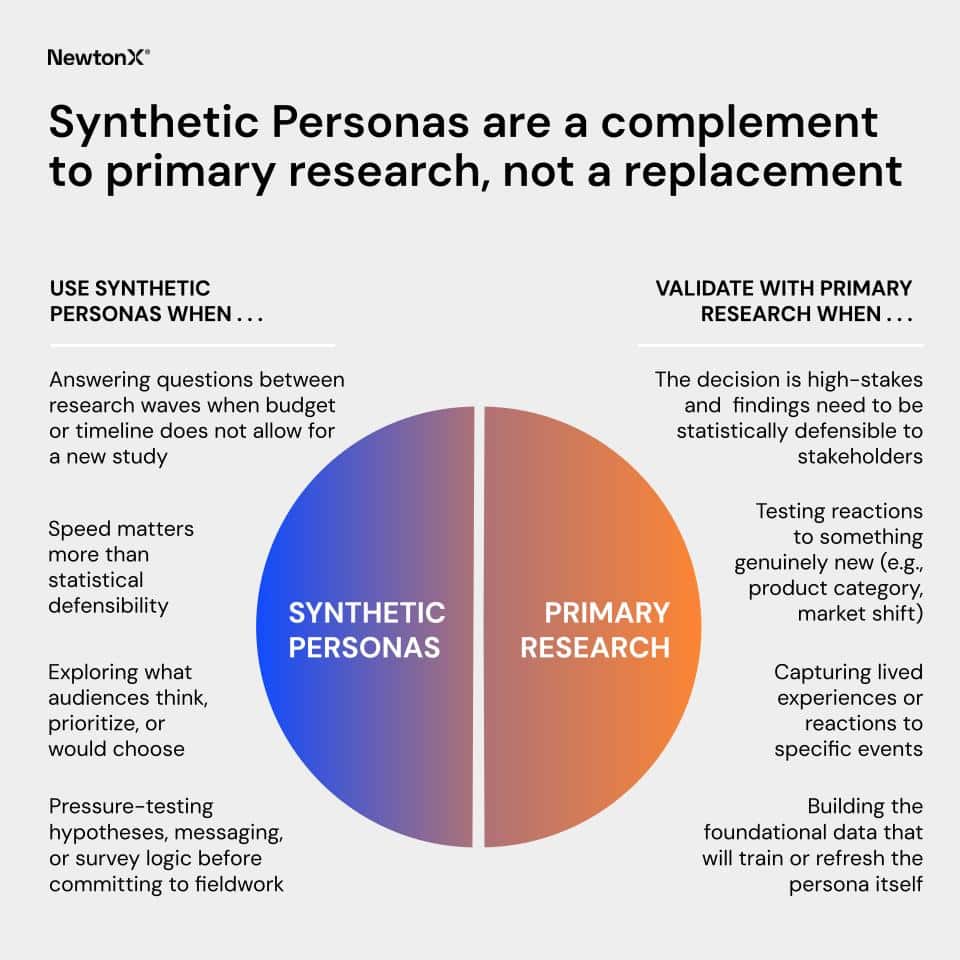
We position each synthetic capability against the decision it serves. For example, synthetic boosting strengthens existing surveys by filling underrepresented segments. Synthetic personas provide directional buyer intelligence between research waves for message testing, hypothesis pressure-testing, and follow-up questions that can’t wait for a new study.
For high-stakes enterprise decisions, primary research with verified professionals remains the gold standard, but that doesn’t mean synthetic personas need to sit outside that process. For instance: Synthetic can be used to sharpen hypotheses, pressure-test survey logic, and narrow down the list of questions worth asking. Then, validate with the verified humans the persona was built on. The two approaches amplify each other.
Novel concepts and genuinely new market shifts will still require fresh primary data. a synthetic persona can’t tell you how buyers will react to a product that didn’t exist when it was trained.
It’s also worth noting that synthetic personas come in two forms:
- Marketplace models are pre-trained on shared data any buyer can access. They’re useful for fast, directional reads on well-documented audiences.
- Proprietary personas are built on your research, your segmentation, and your historical data.
The first gives you intelligence. The second gives you a competitive advantage that compounds every time you add new primary research to the model. Both can be further enriched with our proprietary syndicated data, adding a layer of verified B2B professional insight that off-the-shelf synthetic vendors can’t provide.
3. Will you benchmark your synthetic outputs against real data? How often?
What to listen for: Evidence of ongoing comparative testing with side-by-side comparisons of synthetic outputs versus fresh human panels on the same audience specifications, documented accuracy thresholds, and a clear process for catching model drift over time. Not a one-time validation at launch, but an ongoing practice.
Red flag: A provider who can’t or won’t run comparative benchmarking. Without it, you’re accepting the data on faith, and faith isn’t enough to stake your reputation on a report.
How NewtonX answers it:
We’ve backtested synthetic boosting against independently recruited verified controls across more than 200 studies. The result is 95–99.5% statistical equivalence with fresh, verified professionals sourced separately.
For Synthetic Personas, the benchmarking process works differently: comparing persona outputs against fresh primary research on the same audience to assess whether the model leads you toward the same conclusions a real study would.
Both approaches are designed to surface the same AI-specific failure modes: hallucinations, where the model generates outputs with no grounding in real data, and systematic bias inherited from the training set.
Verified source data produces verified-quality output. Unverified source data gets reproduced just as faithfully, errors included. Validation is repeatable, and benchmarking continues with every engagement.
4. How does your synthetic data stay current? And what happens to the model when new research is available?
What to listen for: A specific, documented process for how new primary research feeds back into the model. Not a fixed update schedule, but a direct link between new verified data and persona refresh. The provider should be able to explain what happens to the model when new studies run.
Red flag: Two patterns to watch for:
1) Providers whose models update by pulling from public data and LLM outputs. In complex B2B industries, that typically means no meaningful change, since the public web doesn’t capture how enterprise buyers actually think and decide.
2) Static models built once and validated occasionally, but never retrained on new research. Both provide a persona that reflects how your buyers thought, not how they think now.
How NewtonX answers it: Our Synthetic Personas refresh every time new primary research is added. New studies feed directly back into the model, which means the persona becomes more accurate over time rather than drifting toward irrelevance. That creates a compounding advantage: Every primary study you run becomes a natural A/B test because you can simulate through the persona before comparing against real verified responses. Providers who can’t connect new research to model improvement are selling you a snapshot, not a system.
Matching method to decision
If you’d reach the same conclusion from synthetic and real data, synthetic earns its place. Boosting is valid with a solid primary dataset but thin subgroups. And synthetic personas are effective when you need directional intelligence between research waves and speed takes precedence over statistical defensibility. For lower-stakes decisions, a well-trained persona can stand on its own.
Researchers are typically making methodological arguments, while CMOs are making budget decisions. The gap between those two conversations is where bad synthetic data procurement happens, and where the right framework makes all the difference, before the vendor is already in the room.
The data foundation compounds for better and worse
As much as some things change in research, at least one stays the same: Your answers are only as good as your data foundation.
Synthetic data is the early layer of where B2B research is heading. Every capability being built on top of it—synthetic personas, agentic research, real-time intelligence systems—inherits whatever’s underneath. Get the foundation right and everything downstream gains integrity. Get it wrong and every layer above amplifies the flaw.
While “not terrible” describes the market floor, a verified data foundation sets the ceiling much higher.
If you’re evaluating synthetic data for B2B research, the questions in this piece are designed to be used in a vendor conversation, including ours. If you want to see how NewtonX answers each one, we’ll walk you through the validation data, the methodology, and the specific capabilities behind every answer.
Sign up for our newsletter, NewtonX Insights:
Related Content
Supermetrics set out to measure marketing’s AI adoption gap. The data proved it’s deeper than anyone expected.
Signal vs. Noise: The hypothesis: Wasn’t AI supposed to fix this? More than 750,000 marketers and analysts turn to the Supermetrics platform to understand what’s actually happening with their data—and over 15% of global ad
read moreA field guide to synthetic data in B2B research
By Jason Talwar, Principal VP, Methods & Innovation The terminology around synthetic data in B2B research is inconsistent. Vendors use the same words to describe different methods. Practitioners inherit definitions from consumer research that don’t
read moreWhat is a synthetic persona? Explaining the synthetic research method built on your own buyers
Learn more about how synthetic personas simulate audience segments you can query on demand between studies—without ever going back to the field. A synthetic persona is one of four methods filed under the label of
read moreInside NewtonX’s verified synthetic research
Synthetic outputs inherit the quality of the data underneath them. Here’s how we build ours, and why the verified foundation changes the output. By Jason Talwar, Principal VP, Methods & Innovation Most synthetic research succeeds
read moreNewtonX announces the first B2B Synthetic Personas solution, giving enterprise teams on-demand buyer insights built on identity-verified professional data
Businesses can now simulate how their specific buyers would respond to messages, concepts, and decisions without waiting for the next study cycle NEW YORK, June 23, 2026—NewtonX today announced the launch of its Synthetic Personas,
read moreThe State of AI in B2B Research
A qualitative report on how senior research and insights leaders are adopting AI, and the trust gap opening up underneath it. About this report: This report draws on in-depth interviews with senior research and insights
read more