















![[Webinar Recap] Is B2B ready for synthetic sample? Yes – if you know how to augment it](https://www.newtonx.com/wp-content/uploads/2024/10/Webinar-synthetic-sample-greenbook-1024-1920px-feature-image-1-300x169.jpg)
![[Webinar Recap] The future of B2B research starts with the death of panels](https://www.newtonx.com/wp-content/uploads/2024/07/TKH-8.22-Karine-Pepin-webinar-1920px-feature-image-300x169.jpg)
![[Webinar Recap] Ditch the Bad Data with Greenbook’s Lenny Murphy as Your Guide](https://www.newtonx.com/wp-content/uploads/2024/05/tkh-greenbook-newtonx-lenny-murphy-cutting-research-cost-speakers-v-21920px-feature-image-300x169.jpg)
The Small Business Banking Report 2026
By Jordan Boeder, Senior Director, Strategic Insights and Analytics
Small business owners do not want a more impressive bank. They want a less frustrating one.
Banks have spent years trying to look more innovative. Small business owners reward something simpler. They choose banks that feel stable, move without friction, and understand how the business actually runs.
Stability over innovation is the clearest takeaway from a NewtonX survey of 102 verified US small business owners, each responsible for choosing and managing their company’s primary banking relationship. The findings challenge a lot of banking marketing. Security matters, but it does not separate winners from the pack. AI only matters when it quietly removes work. Relationships matter, but they do less to protect retention than many banks assume.
Most banks are not speaking to what small business owners actually value. This report also makes a second point by example: if you want to understand small business owners well, you need direct access to verified small business owners rather than a proxy audience.
1. The banking technology that resonates with small business owners is practical and operational
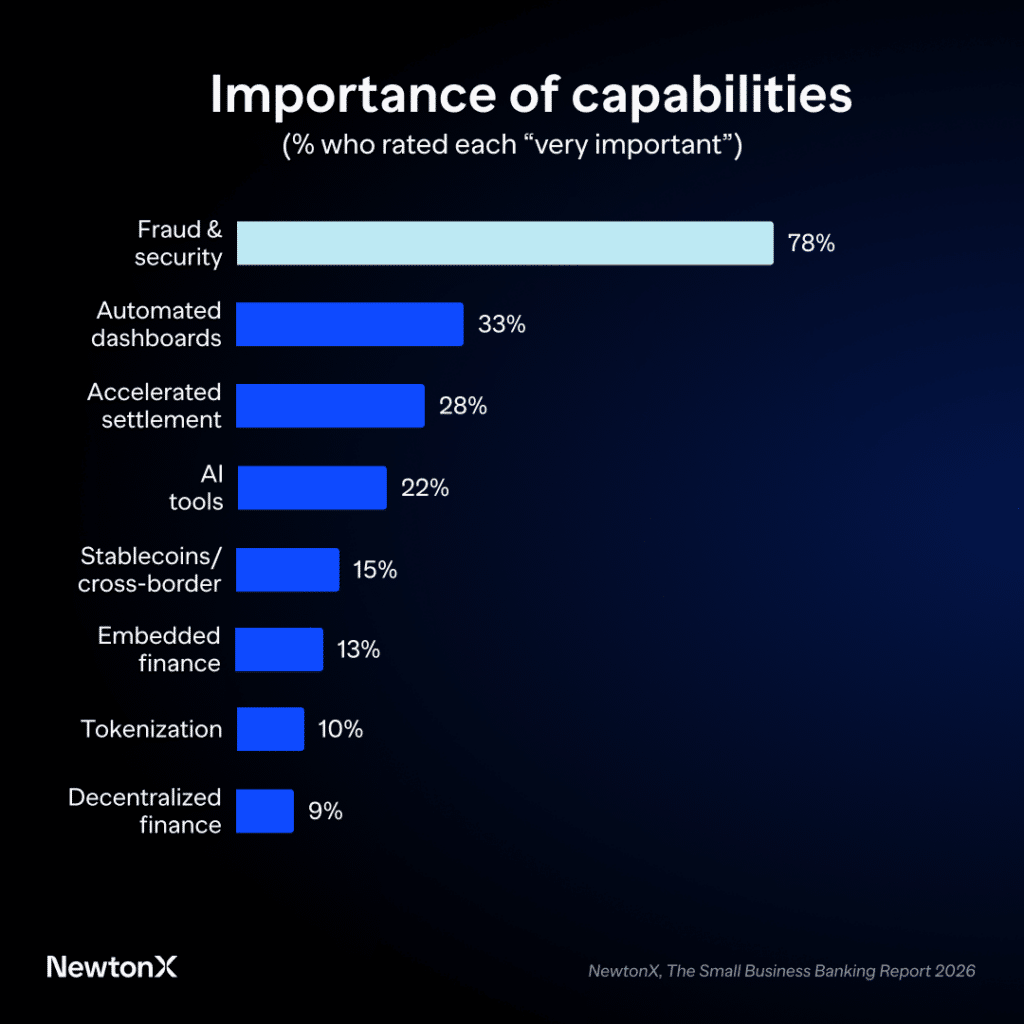
When small business owners rate banking technology capabilities, fraud detection and security sit far above the rest. In NewtonX’s survey, 78% rate them very important, more than double the next-closest capability. Automated dashboards (33%), accelerated settlement (28%), and AI-powered tools (22%) form a distant second tier, while crypto-adjacent capabilities trail the field.
At first glance, that result might tempt a bank to double down on security messaging. That would miss the point.
Security is essential. It also fails to differentiate. Only 3% of owners say their current bank falls short on fraud or security tools according to NewtonX’s survey. Owners expect competence here. Most banks clear that bar. A capability everyone expects and everyone assumes does not do much to explain why one bank wins over another.
The key driver analysis makes that mismatch clear. Across ten brand attributes, only three emerge as statistically reliable drivers of consideration: being seen as financially stable, easy to work with, and understanding the customer’s business. Security scores high in apparent importance, yet it does not show up as a reliable driver.
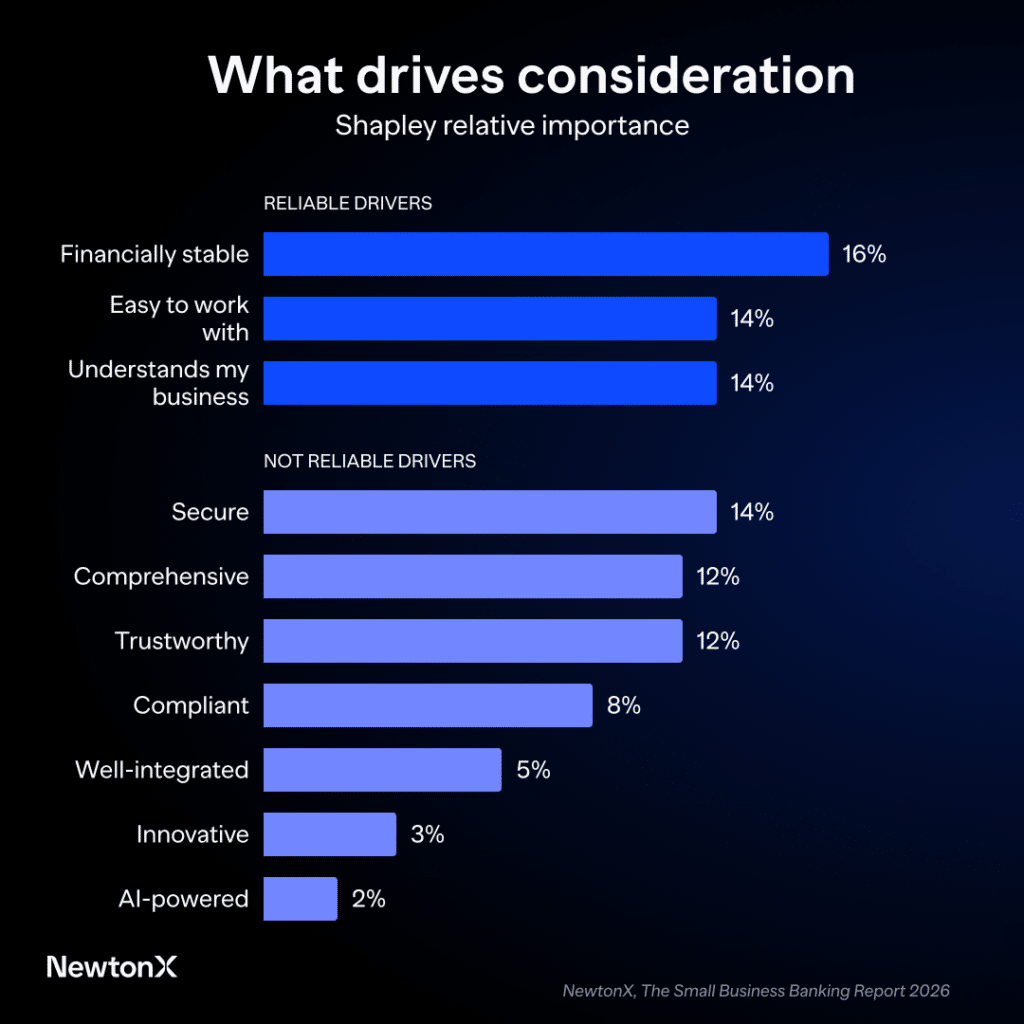
That changes how banks should talk. Security belongs in the proof set but it should not carry the whole pitch. Owners use it to rule banks out. They do not use it to pick a winner.
AI earns attention when it clears work off the desk
The same pattern shows up in how owners think about AI.
Only 22% of small business owners rate “AI-powered tools” as very important in the abstract. That sounds underwhelming until you ask about interest in specific use cases. Then the appetite becomes obvious. Small business owners want AI that catches fraud in real time, integrates with accounting and ERP systems, auto-categorizes and reconciles transactions, flags cost savings, automates payments and approvals, and gives them faster access to the numbers.
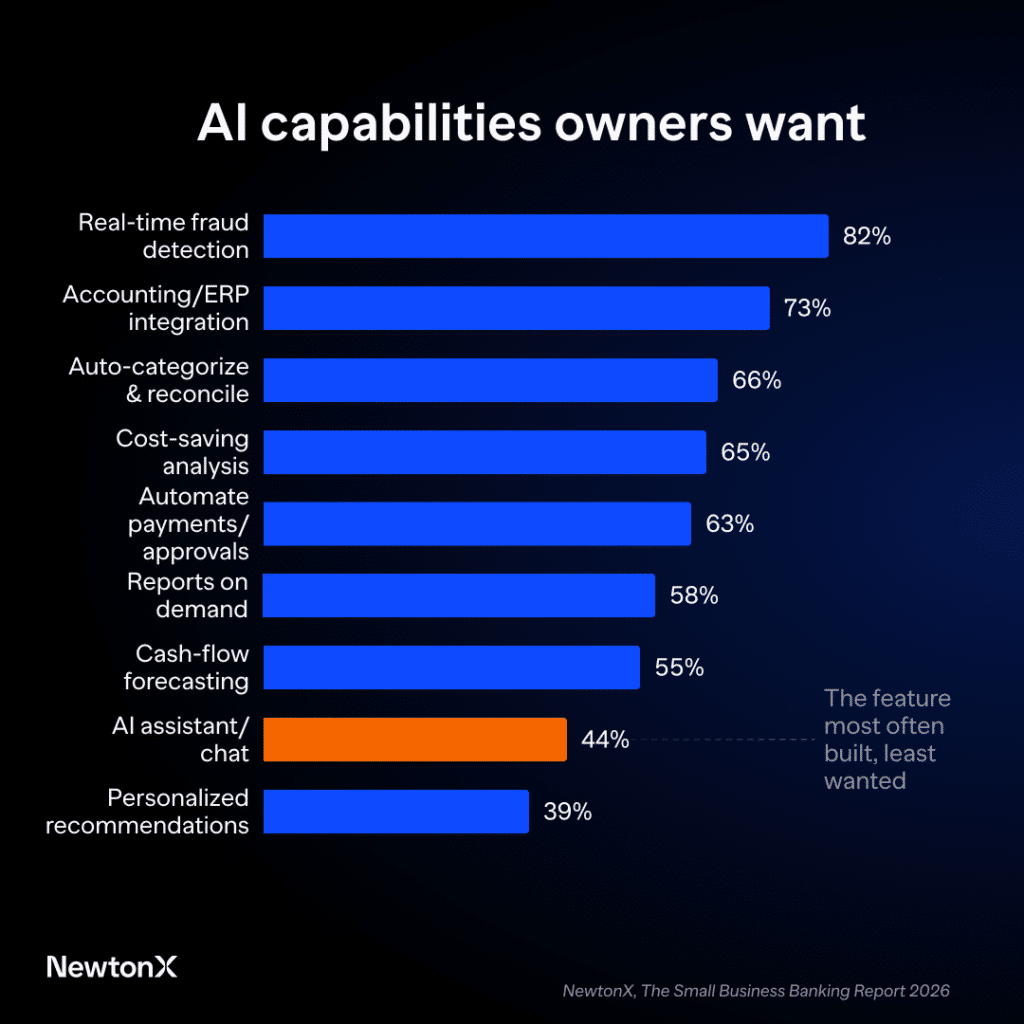
The pattern is evident: Owners want labor removed. They want fewer manual tasks, fewer loose ends, and better visibility into the business.
They show far less interest in the feature many banks seem most excited to market: the AI assistant. It ranks near the bottom at 44%. One owner put it plainly: “I would not want AI assisted chat. I want to chat with a real person.”
The branding implication is clear. AI works best as invisible help. It is far less effective as a headline. When NewtonX asked which messages would feel inauthentic coming from a bank, “AI-powered” came in first at 53%. Owners do not reward banks for sounding futuristic. They reward banks for making the workday easier.
That practical filter shows up in what frustrates owners about their current bank. The most common shortfalls are limited AI or automation at 50%, weak reporting and analytics dashboards at 35%, and difficult software integrations at 29%. These are back-office problems. Banks that solve them create value customers feel immediately.
Crypto carries far more weight inside the industry than it does with owners
Some of the most heavily discussed topics in fintech have limited resonance with this audience. Stablecoins and cross-border payments reach just 15%, followed by tokenization (10%) and decentralized finance (9%). These are also the only capabilities that a majority of owners rate as unimportant.
That does not mean every crypto-related capability lacks value. It means most small business owners do not see crypto as a reason to choose a bank. Banks that make it central to their story risk spending energy on a signal the audience barely hears.
2. The banker relationship is real for small business owners. But it’s not the retention engine many banks think it is.
Small business owners value the human side of banking. One owner summed it up well: “I am able to walk four blocks down the street to meet with a human being that supports me immediately.” That matters, but it does not tell the full loyalty story.
When owners explain why they stay with their current bank, only 35% describe it as an active choice according to NewtonX’s survey results. Sixty-three percent say they stay at least partly because switching feels like too much effort.
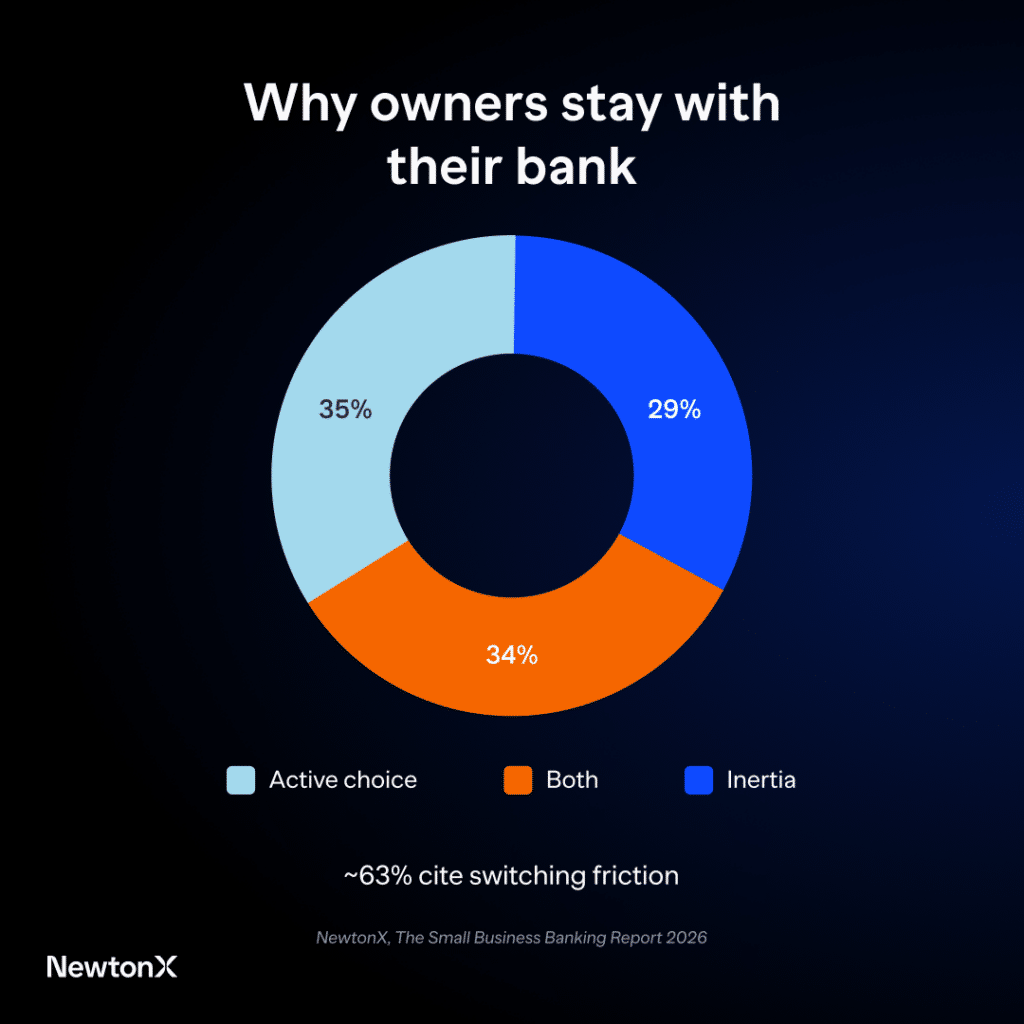
That is a more restrained picture of loyalty than many banks assume. A meaningful share of retention comes from friction.
The switching data pushes the point further. Asked what would most likely move them to another bank, owners point first to a major trust or service failure (44%), with lower fees or better pricing (37%) and a clearly better digital experience (36%) close behind. A stronger personal relationship sits further back at 29%.
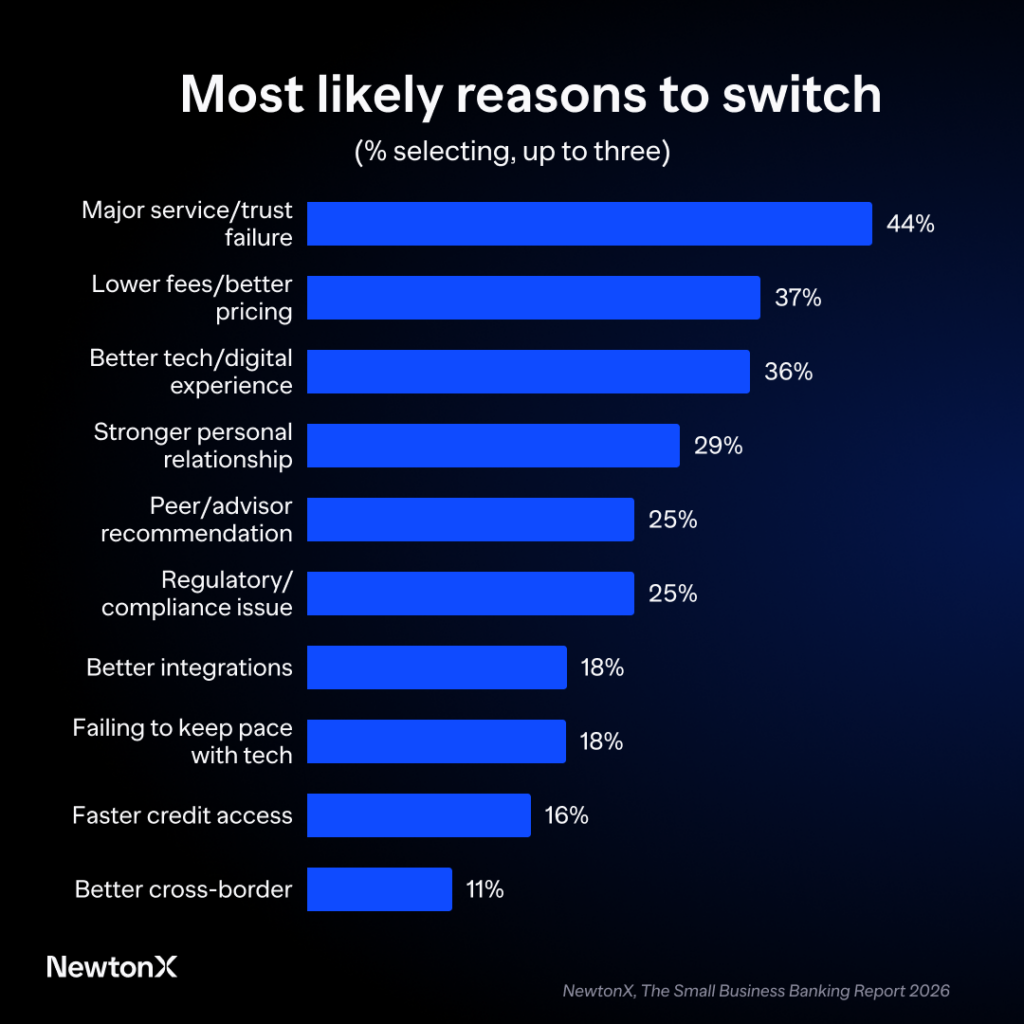
Banks should still invest in relationships. They create goodwill. They buy patience. They can soften the edges when something small goes wrong.
Yet, relationships do not override price pressure, digital disappointment, or a break in trust. Retention still rides on fundamentals.
3. Heritage banks and tech-positioned providers trigger opposite anxieties
Small business owners do not judge every bank through the same lens. The concerns shift with the kind of provider in front of them.
When a bank positions itself as technology-first, owners ask whether it is stable enough, proven enough, and durable enough to trust. The top concerns for technology-positioned providers are being too new or unproven (76%), lacking stability or regulatory standing (75%), and moving too fast (38%).
When a bank leans into heritage, the concern reverses. Owners start worrying about speed and capability. The top concerns for heritage providers are slow adoption of technology(64%), weak digital tools(55%), and rigidity (49%) according to NewtonX’s survey.
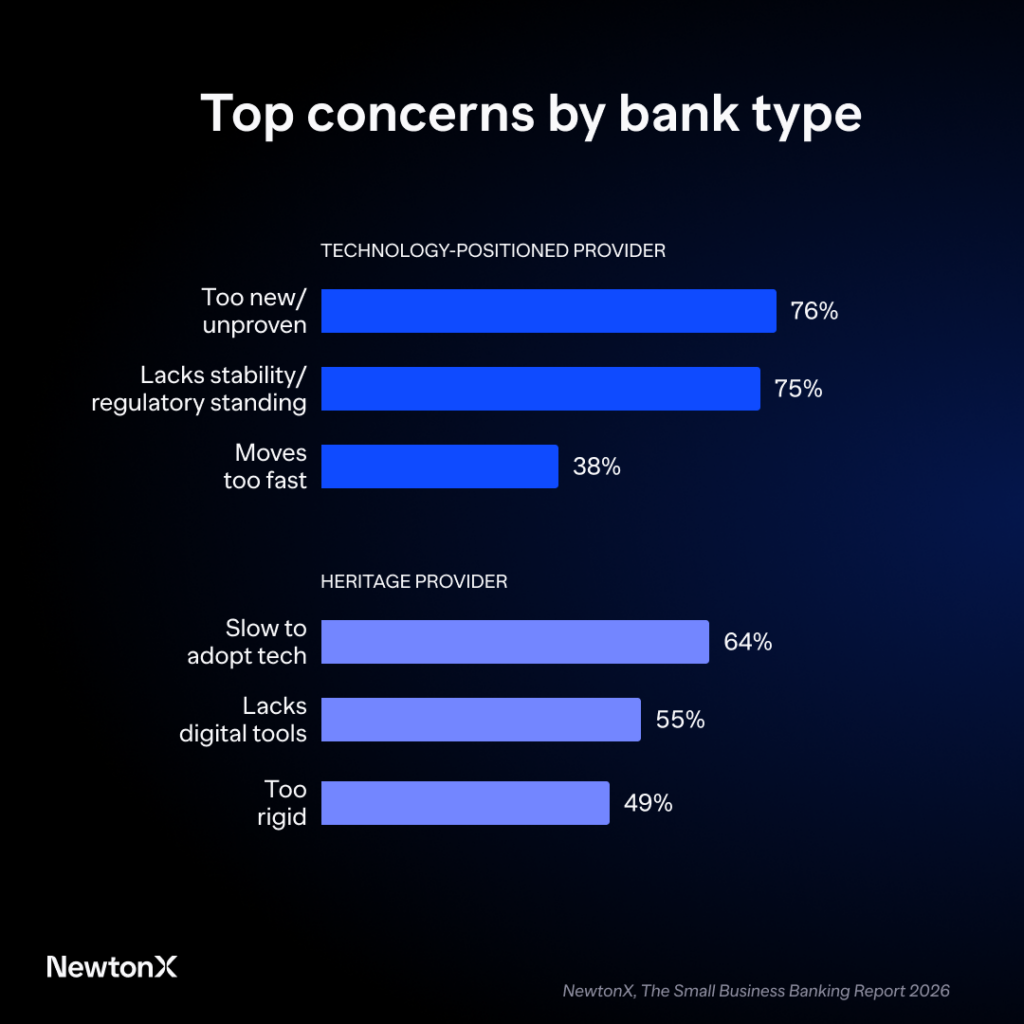
This gives each provider type a much clearer job.
A heritage bank rarely needs to spend core messaging proving it is safe and established. Owners already assume that. Its job is to show that the experience keeps pace.
A tech-positioned provider has the reverse challenge. Owners usually grant the technology story. What they want proof of is durability. Will this provider still be here in five years? Will it provide real support when an issue arises? Will going branchless leave them without a clear path to resolution when the stakes are high?
The “fintech versus bank” label itself carries less weight than industry chatter suggests. Only 17% of owners say they see banks and fintechs as fundamentally different when evaluating a provider. Fifty-six percent weigh the distinction without letting it be a deciding factor. Twenty-seven percent say it does not matter.
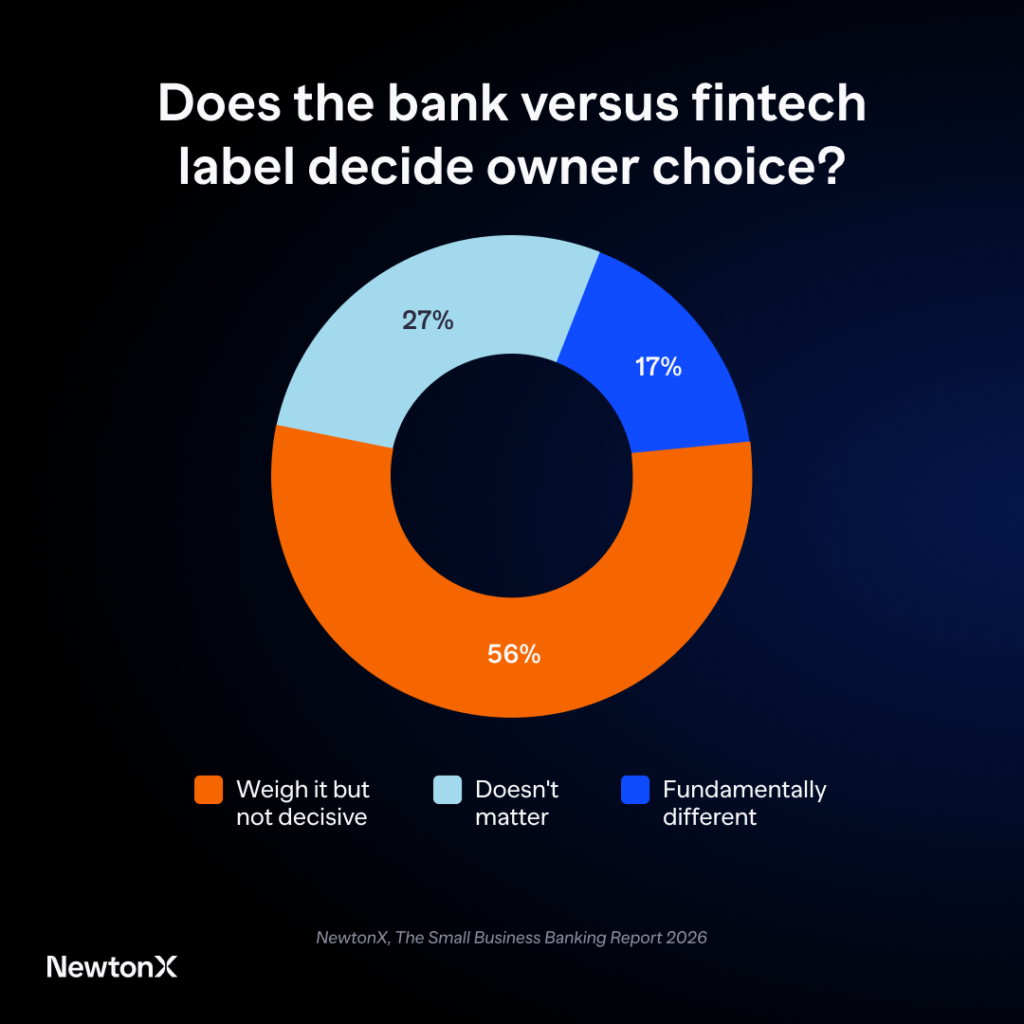
That result makes sense in a market where the categories have already started to blur. Forty-four percent of owners who use heritage banks view that bank as at least somewhat of a technology company. Even so, fintechs still inherit a distinct trust problem. They win when they answer it directly and make the support model feel credible.
Where banks should go from here
The marketing implications for verified small business owners are clear.
- Lead with stability, ease, and business understanding. Those are the clearest reliable drivers of consideration.
- Treat security as reassurance. It is mandatory. It is rarely persuasive on its own.
- Sell technology through the work it removes. Owners respond to saved time, cleaner workflows, and better visibility.
- Match the story to the provider type. Heritage banks need to prove they can keep up. Newer entrants need to prove they will last.
Small business owners want a bank that feels solid, makes fewer demands on their time, and helps the business run with less friction. That is a much less glamorous story than a lot of banking marketing wants to tell.
It is also the one these customers are ready to believe.
About the data
This report draws on a survey of 102 verified US small business owners, each a founder or owner responsible for choosing and managing their company’s primary banking relationship. Most respondents run businesses with fewer than 50 employees. The value of a study like this depends on reaching actual small business owners, not generic respondents who sit near the category.
NewtonX also ran a key driver analysis across 485 brand ratings to identify which brand attributes most closely predict consideration. The model is statistically significant overall and shows that financially stable, easy to work with, and understands my business are the clearest positive drivers. Secure, comprehensive, and trustworthy point in a positive direction, though they do not emerge as individually significant in this model. Innovative and AI-powered do not register as meaningful drivers of consideration.
Commission research like this, or get the data
This study also shows what high-quality B2B primary research looks like. Reaching verified small business owners, and only real decision-makers, remains one of the hardest parts of research in this market. Surveys and interviews rise or fall on audience quality. If you run brand, message, or competitive research for a bank and want the same kind of verified read on small business owners, NewtonX can help.
Want to explore the findings in more detail?
Reach out to download the underlying survey data from 102 verified US small business owners—and uncover what really drives bank consideration, loyalty, switching, and demand for practical AI.
Sign up for our newsletter, NewtonX Insights:
Related Content
The State of AI in B2B Research
A qualitative report on how senior research and insights leaders are adopting AI, and the trust gap opening up underneath it. About this report: This report draws on in-depth interviews with senior research and insights
read moreBain chose NewtonX to conduct the research behind a new metric for predicting B2B deal wins.
This metric stands apart because it focuses on decisions that actual buyers make in head-to-head comparisons… Likelihood to Buy turns growth from guesswork into precision, linking targeted actions directly to higher win rates and tangible
read moreWhat a $7.2B branding mistake teaches finance firms about M&A
In 2013, Microsoft acquired Nokia’s phone business for $7.2 billion. Less than two years later, it wrote off nearly the entire value of the deal. The technology story behind that failure has been well‑documented. What
read more