

















![[Webinar Recap] Is B2B ready for synthetic sample? Yes – if you know how to augment it](https://www.newtonx.com/wp-content/uploads/2024/10/Webinar-synthetic-sample-greenbook-1024-1920px-feature-image-1-300x169.jpg)
![[Webinar Recap] The future of B2B research starts with the death of panels](https://www.newtonx.com/wp-content/uploads/2024/07/TKH-8.22-Karine-Pepin-webinar-1920px-feature-image-300x169.jpg)
![[Webinar Recap] Ditch the Bad Data with Greenbook’s Lenny Murphy as Your Guide](https://www.newtonx.com/wp-content/uploads/2024/05/tkh-greenbook-newtonx-lenny-murphy-cutting-research-cost-speakers-v-21920px-feature-image-300x169.jpg)
How CMOs are balancing revenue growth and brand building in 2026

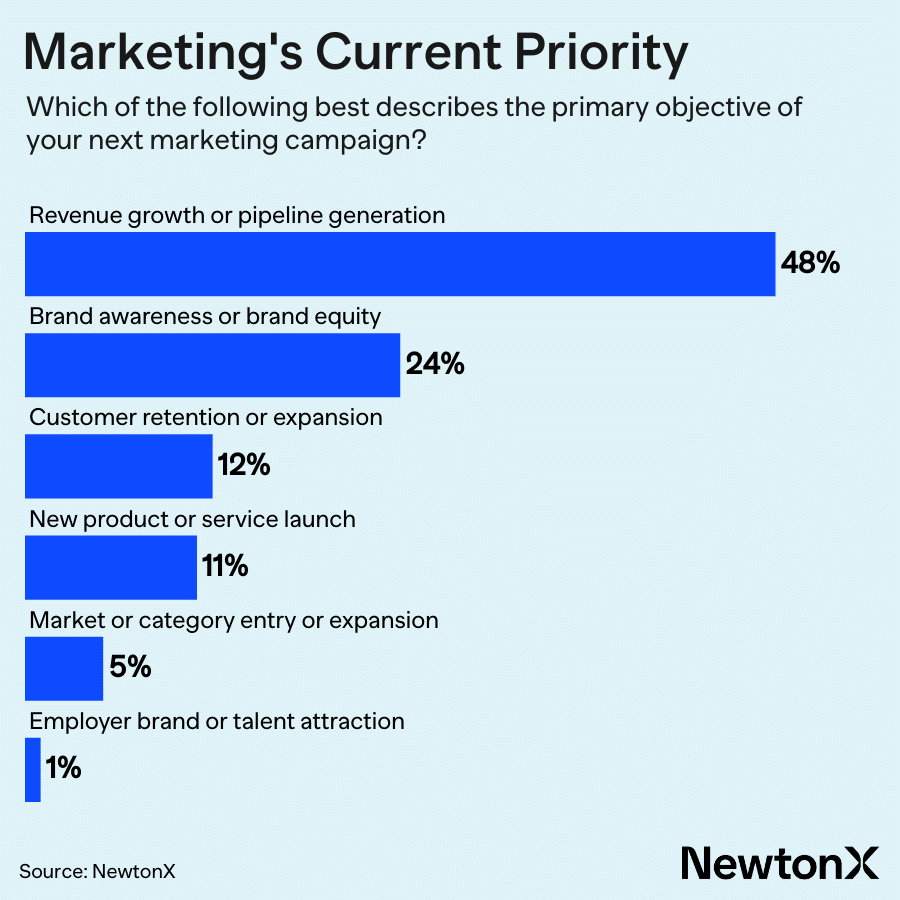
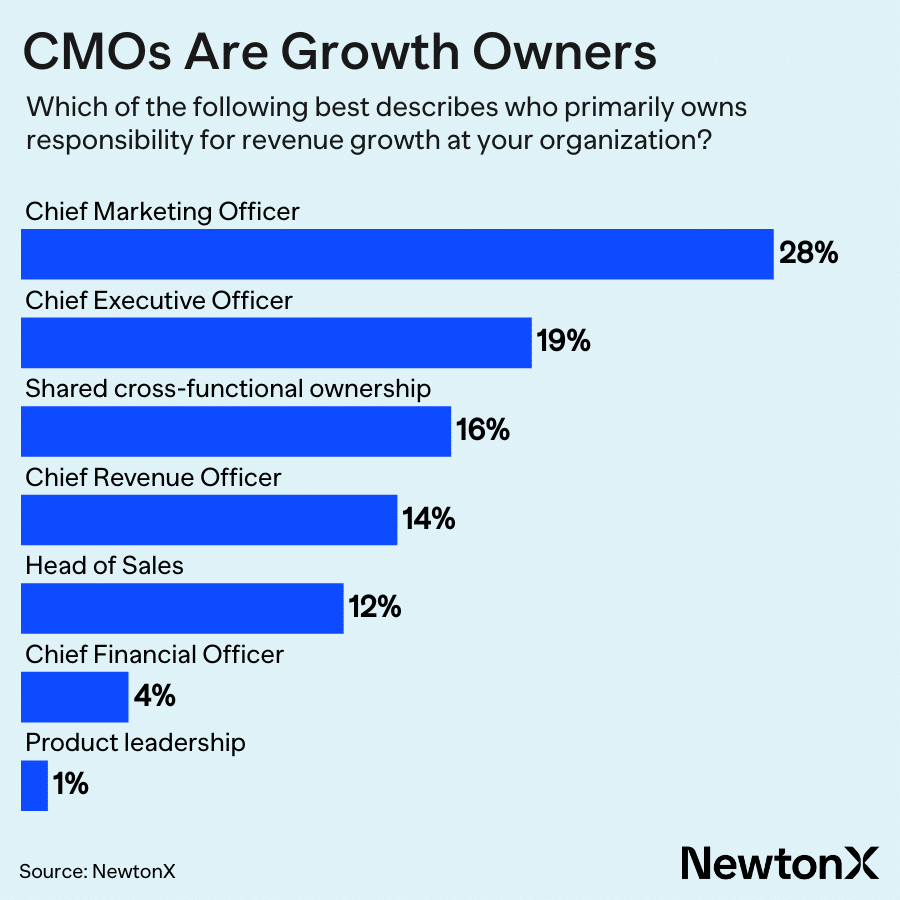
CMOs face an unprecedented challenge this year: balancing the urgent need for near-term revenue growth with the imperative to protect and build long-term brand equity. NewtonX and Adweek research shows a stark divide, with 48% of marketers prioritizing revenue growth as their primary objective, while only 24% focus on brand awareness.
This shift reflects intense pressure from C-suite leaders to demonstrate measurable ROI amid budget constraints, evolving customer expectations, and rapid AI adoption. Yet, brand health remains a critical foundation for sustainable growth and competitive advantage.
Why revenue has jumped ahead of brand
The emphasis on revenue growth is driven by three converging forces:
- Macro uncertainty: Economic volatility, geopolitical risks, and tighter budget scrutiny compel boards and executives to demand faster payback from marketing investments. CMOs are expected to prioritize initiatives that deliver tangible business outcomes within shorter cycles, making revenue-focused campaigns the default choice.
- Organizational pressure: The CMO role has expanded beyond traditional marketing campaigns to owning revenue growth through new customer acquisition, demand generation, and customer lifecycle management. Performance metrics such as pipeline coverage, customer acquisition cost (CAC), and win rates are under constant review, with marketing held accountable for direct contributions to sales.
- AI and efficiency expectations: Generative AI and AI agents automate creative production, media buying, and analytics, enabling teams to do more with less. By 2026, a majority of marketing technology leaders are piloting or scaling AI tools across content marketing, Google Ads optimization, and customer insights. This efficiency raises the question: if AI accelerates output, why isn’t every marketing dollar driving visible revenue?
Given these pressures, it’s understandable that nearly half of marketing decision-makers prioritize revenue growth over brand awareness. However, over-rotating toward short-termism risks eroding the very brand equity that underpins pricing power, customer loyalty, and sustainable growth.
Brand still matters more than ever
Brand remains a vital asset, especially in complex B2B buying environments where price is rarely the sole factor. Alfred DuPuy, managing director at Brand Finance North America, emphasizes that brand acts as a signal of value, trust, authenticity, and risk reduction. In markets crowded with alternatives and price-sensitive buyers, brands that deliver value beyond price consistently outperform.
Measurable benefits of strong brands include:
- Higher conversion rates and win rates: Strong brands can achieve up to 30% better performance in competitive deals, as trust built by brand reputation shortens sales cycles and improves buyer confidence.
- Lower customer acquisition costs: Brands with high recognition experience up to 26% lower CAC, reducing marketing expenses and improving ROI.
- Greater resilience: Customers show more tolerance for occasional missteps or product issues when they trust the brand, and strong brands withstand aggressive competitor discounting.
In essence, brand building amplifies the efficiency of performance marketing. It increases mental availability and the likelihood that potential buyers will choose your offering when they enter the buying process, reducing time spent in consideration and preventing leakage to competitors.
What a strong brand requires in 2026
Building and maintaining a strong brand in today’s fragmented landscape demands alignment across several fundamentals:
- Awareness: Are the right target audiences aware of your brand’s existence, and have you invested in systematic brand awareness research to understand how well you’re recognized and recalled?
- Familiarity: Do they understand your value proposition and offerings?
- Consideration: Are you included on the shortlist when buyers evaluate options?
- Reputation: Is your brand perceived as credible, high quality, and trustworthy?
- Reliability: Do you consistently deliver on your promises across all touchpoints?
- Differentiation: Is there a clear, memorable “only we” that sets you apart?
- Value and pricing: Does your offering feel worth its price?
- Consistency of experience: Does every interaction—from sales to content marketing to customer support—reflect the same brand promise, and are you tracking that through structured brand awareness survey questions over time?
The buying process now involves multiple stakeholders across departments, and digital information flows ahead of sales conversations. Media fragmentation spans social platforms, retail media networks, newsletters, and niche communities, raising the bar for confident B2B marketers who can quantify impact across channels. Maintaining a coherent brand narrative across this complex ecosystem requires strategic focus and discipline.
CMOs must guard against confusing activity with strategy; launching brand campaigns or content formats merely because they are possible dilutes impact. Instead, every initiative should ladder up to a clear brand strategy and target the right audience segments with relevant messages.
Occasional “cashing in” of brand equity for short-term gains, such as direct-response pushes or limited-time discounts, is acceptable if done transparently, tracked rigorously, and followed by deliberate reinvestment in brand-building programs like thought leadership, research-backed content, and superior customer experiences.
Where AI fits and where it still doesn’t
AI is woven into marketing operations, powering creative concepting, copy generation, asset versioning, dynamic optimization, and forecasting. By 2026, most enterprise marketing teams will use generative AI tools daily to support demand generation, content marketing, and continuous testing.
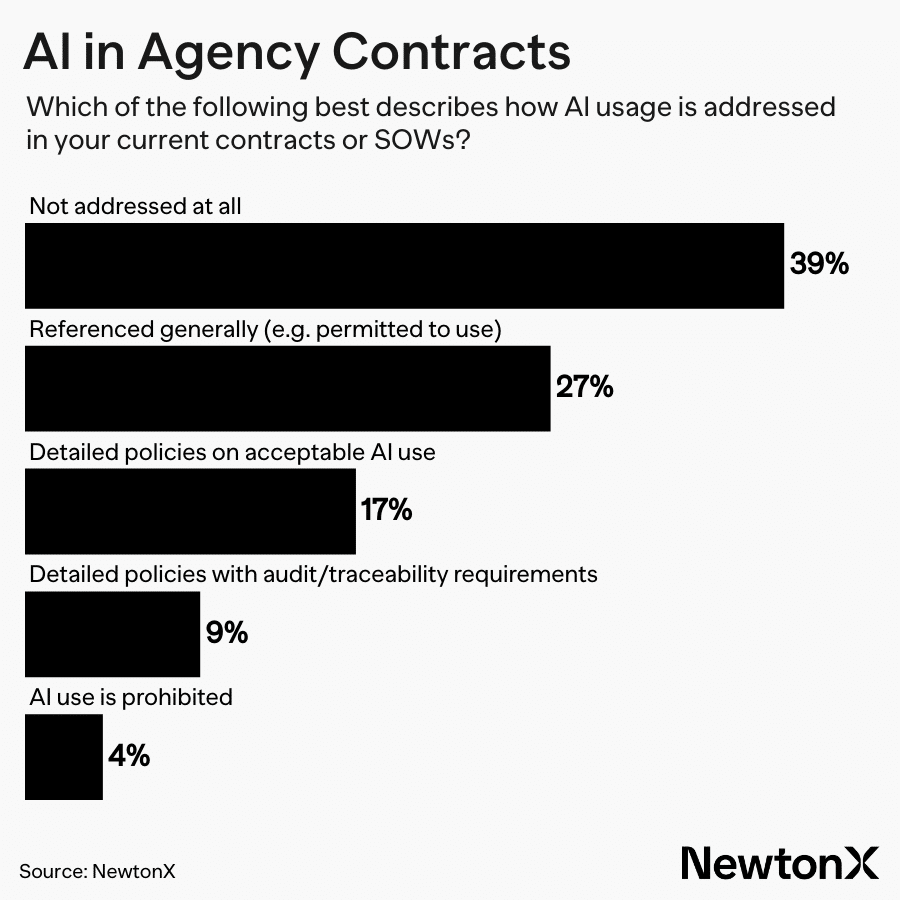
Yet NewtonX–Adweek data reveals a notable disconnect: 39% of agency contracts omit AI language entirely, and 27% mention AI only vaguely. This gap between AI’s operational use and its economic governance poses challenges for CMOs:
- Pricing and value: Traditional hourly or output-based billing models don’t align well with AI-driven efficiencies. Without outcome-based pricing, cost savings may translate into budget cuts rather than reinvestment in growth initiatives.
- Transparency and trust: Boards and stakeholders increasingly demand clarity on how AI and generative AI tools are used, including data handling, originality, and intellectual property considerations. Silent contracts expose brands to reputational risk without clear recourse.
- Differentiation: As AI-generated content floods search engines and social media, authentic brand voice, human creativity, and ethical governance become critical competitive advantages that AI alone cannot replicate.
Leading CMOs proactively update contracts, compensation models, and governance frameworks to reflect AI’s role. They treat AI as a force multiplier for testing and insight generation, not a substitute for strategic brand thinking, increasingly exploring digital twins and synthetic customers in product marketing to pressure-test messaging before launch. Efficiency gains from AI are reinvested into brand-building programs, improved customer experiences, and deeper research to unlock growth opportunities, especially as platforms like TikTok redefine AI automation leadership in advertising.
How leading CMOs are balancing brand and revenue
High-performing marketing organizations in 2026 demonstrate these behaviors:
- Define an explicit brand/performance marketing mix: Many set portfolio-level targets around a 60/40 split, revisited quarterly to maintain a sustainable balance between short-term results and long-term growth.
- Connect brand metrics to commercial outcomes: Brand health is tracked alongside pipeline velocity, win rates, pricing power, and customer behavior, integrating marketing performance with finance and sales dashboards.
- Design creative to serve dual purposes: Brand platforms support both upper-funnel storytelling and lower-funnel performance campaigns across search, social media, and email, unifying messaging and improving efficiency.
- Reserve protected brand budgets: A portion of spend is ring-fenced for brand initiatives regardless of near-term pressures, with optimization focused on reach and mental availability among priority segments.
In short, these CMOs treat brand and performance as complementary levers in the same system, driving sustainable, compounding revenue growth.
Five practical moves for CMOs in 2026
To rebalance without losing momentum, CMOs should:
- Reframe marketing’s mandate: Align with CEOs and CFOs to position marketing as a growth engine accountable for revenue and asset value. Use data linking brand strength to pricing power, higher conversion rates, lower CAC, and improved win rates.
- Codify the brand-performance split: Establish target budget allocations by market and product (e.g., 60/40 or 50/50), communicate them internally, and make deviations explicit decisions rather than default reactions to quarterly pressures.
- Upgrade measurement stacks: Integrate brand tracking with pipeline and revenue analytics. Invest in systematic research, as firms that conduct regular prospect and client research grow significantly faster and more profitably, and can better communicate how brand impacts share price and valuation.
- Audit contracts for AI and value alignment: Collaborate with legal, procurement, and martech teams to update agency contracts and statements of work. Explicitly address AI use, data governance, and shift toward outcome-based pricing models, informed by executive perspectives on generative AI adoption in marketing.
- Pressure-test brand risk in your portfolio: Identify over-reliance on discounting, hyper-tactical lead-gen gimmicks, or channel tactics that fail to build memory structures with your target audience. Document “cashing in” of brand equity and plan replenishment through thought leadership, better experiences, and clearer value stories.
The balance between revenue growth and brand building has always been delicate. In 2026, the accelerating pace of technology, shifting customer expectations, and budget scrutiny make it imperative for CMOs to treat brand and performance as inseparable levers. By rebuilding data systems, contracts, and culture around this reality, marketing can drive sustainable, compounding business growth well into the future.
Sign up for our newsletter, NewtonX Insights:
Related Content
Why ad agencies without solid market research will fall behind in 2026
Just 13% of B2B marketing leaders are confident their agency partners possess accurate data about their customers to make smart advertising campaigns that work. That’s not a whole lot—especially when considering the purpose of the
read moreWhy market research is the LLM unlock
By Lance Worley, RVP Technology Accounts In B2B tech, your next customer is increasingly not starting on Google or in a Gartner quadrant. They’re opening ChatGPT, Claude, or Gemini and asking a simple question: “What
read moreB2B’s brand budget problem is a confidence gap, not a belief gap
By Paul Hiebert | Editor, Ad Current On the surface, convincing someone to grab an energy drink looks nothing like persuading a buying committee to sign a multi-year contract for payroll software or a new
read moreThought leadership isn’t thoughtful without real industry insiders
The biggest gap in your marketing strategy isn’t your tech stack—it’s who your data actually comes from. In a NewtonX A/B validation study on business intelligence software, panel respondents and verified BI decision-makers differed by
read more