
















![[Webinar Recap] Is B2B ready for synthetic sample? Yes – if you know how to augment it](https://www.newtonx.com/wp-content/uploads/2024/10/Webinar-synthetic-sample-greenbook-1024-1920px-feature-image-1-300x169.jpg)
![[Webinar Recap] The future of B2B research starts with the death of panels](https://www.newtonx.com/wp-content/uploads/2024/07/TKH-8.22-Karine-Pepin-webinar-1920px-feature-image-300x169.jpg)
![[Webinar Recap] Ditch the Bad Data with Greenbook’s Lenny Murphy as Your Guide](https://www.newtonx.com/wp-content/uploads/2024/05/tkh-greenbook-newtonx-lenny-murphy-cutting-research-cost-speakers-v-21920px-feature-image-300x169.jpg)
Thought leadership isn’t thoughtful without real industry insiders

The biggest gap in your marketing strategy isn’t your tech stack—it’s who your data actually comes from.
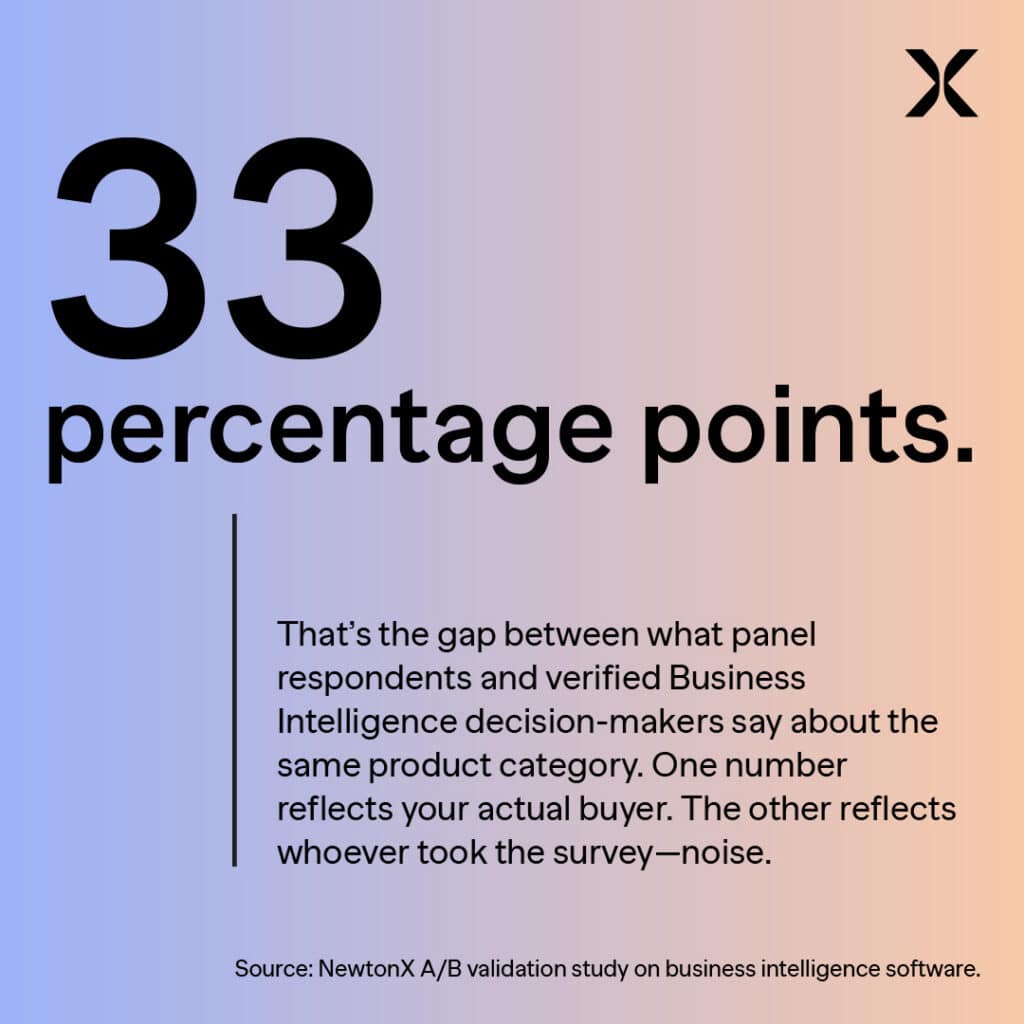
In a NewtonX A/B validation study on business intelligence software, panel respondents and verified BI decision-makers differed by 33 percentage points on the same product category. One number reflected real buyer behavior; the other was noise. This gap isn’t minor—it’s the difference between basing your go-to-market strategy on reality versus a hallucination.
Understanding how poor data inputs distort B2B market research and weaken your B2B thought leadership is crucial. More importantly, knowing what to do differently can help you deliver genuinely new insights instead of recycled bad data.
1. Why “more data” isn’t better insight
Political leaders know public polling and insider intelligence serve different purposes. Polls gauge general sentiment, but critical decisions come from conversations with a small circle of insiders whose influence matters. These insiders aren’t clicking through surveys for incentives.
Enterprise tech is in the same place.
- Surface metrics like adoption or awareness are cheap to collect.
- The real decision-makers—often six to ten people across IT, finance, security, procurement, and business units—are few, busy, and hard to reach.
Treating this group as a single “ITDM persona” makes your thought leadership generic, not grounded.
This is clear in AI adoption. Enterprise surveys show expectations shifting from soft productivity gains toward measurable financial impact, yet research like MIT’s GenAI Divide reveals a 95% failure rate for generative AI projects within six months. This shift shows how executives are adjusting their views to focus on real-world results. Buyers have moved from optimism to scrutiny. If your insights rely on generic panels or outdated assumptions, your content speaks to the 2024 buyer, not 2026.
2. How bad inputs distort your market view
Most B2B marketing teams rely on three main data sources, and the stakes are higher than in B2C versus B2B market research because you’re dealing with smaller, more specialized audiences:
- Panel-based surveys
- Synthetic or modeled data
- Internal anecdotes from sales, customer success, and product teams
Each has value but also risks when treated as the whole truth.
Panels suffer from audience drift. They skew toward habitual survey-takers with time and incentives, not senior decision-makers with limited availability. Job titles are often self-reported, and identity verification is minimal. Over time, you end up with quantitative data that looks clean but doesn’t reflect your actual decision-makers.
Synthetic data depends on its base. Synthetic samples in B2B research can fill gaps when decision-makers are scarce or costly to recruit, but if trained on generic consumer data, opt-in panels, or scraped signals unrelated to your buyer, it confidently models the wrong people.
Internal anecdotes prioritize the loudest voices. Sales and CS teams see real deals but only a subset of accounts, often at specific maturity stages. Without external benchmarks, it’s easy to overweight one region, vertical, or large customer’s needs, skewing your strategy toward a few stories instead of the full market.
None of these sources are useless. The problem arises when they aren’t anchored in a verified insider truth layer. Without that, B2B thought leadership amplifies distortions instead of correcting them.
3. Audit the “who” behind your data
Before choosing topics or formats, run a quality check on your inputs using key KPIs to elevate data quality in market research. This is basic B2B market research hygiene.
Ask:
- Identity
- Do you know who every respondent really is, beyond a self-reported title?
- Can you verify their company type, size, and seniority?
- Relevance
- Are you talking to budget owners, problem owners, or blockers?
- Or to anyone touching the category, including those with little buying influence?
- Diversity within the buying group
- Are you hearing separately from economic buyers, technical evaluators, security leaders, and procurement?
- Or are they collapsed into a single “IT decision-maker” segment?
- Cadence
- When did you last refresh your audience view?
- Does the pace of change justify quarterly, semiannual, or annual updates?
If you can’t answer these clearly, you lack the insider layer needed. You may have data, but not the precision to underpin a strong point of view.
4. What insider-grade research looks like
Insider-grade B2B research meets a standard across three dimensions.
Who you recruit. You go beyond single panels into open networks across industries and functions, not closed pools of habitual survey-takers. You use multi-layer verification—LinkedIn checks, unique links, IP and metadata review—to ensure real people matching your target. Incentives reflect senior decision-makers’ time value, often requiring higher honoraria than consumer research.
How you blend methods. You combine qualitative and quantitative research deliberately. Qualitative interviews and focus groups surface critical questions, language, and mental models your customers use. Quantitative surveys test those patterns at scale with verified decision-makers. Together, they yield reliable data and unique insights on brand perception, product fit, and sales strategy competitors can’t replicate.
How you treat synthetic and automation. Synthetic data extends verified insight, not shortcuts hard-to-reach audiences. It fills gaps when human samples are scarce or costly, but quality depends on the underlying human data. Without rigorous validation, it amplifies errors and misleads decisions.
With this foundation, you ask sharper questions, like:
- Which functions are truly scaling AI, and where are bottlenecks in governance, security, or data quality?
- Why do only a fraction of leaders feel ready to deploy agentic AI strategically?
These questions produce real thought leadership, not trend summaries.
5. Turning insider research into real B2B thought leadership
With insider-grade inputs, design programs that feel like conversations your buyers already have behind closed doors.
Use a LEAP-style loop for thought leadership:
- Listening: Use primary research with verified decision-makers to understand current struggles, not social media guesses.
- Extracting: Distill a few non-obvious insights that change how sales, product, or marketing leaders think about risk, value, and advantage.
- Articulating: Craft clear narratives that help clients think differently instead of promoting one company or tool.
- Promoting: Share narratives consistently in formats your audience consumes—research reports, LinkedIn articles, webinars, podcasts.
Original research and micro-studies are especially powerful. They provide objective, proprietary data competitors can’t replicate. Clients prefer customized, up-to-date insight over generic stats.
Done well, this builds authenticity. In B2B, authentic, high-value, non-promotional insights foster trusted expertise and long-term relationships. This approach outperforms traditional marketing because it educates rather than pitches.
If your thought leadership relies on generic panels, outdated assumptions, or synthetic data with unclear provenance, it will only restate familiar ideas. It might generate clicks but won’t change minds.
Treat who you talk to as your first design decision. Refresh your audience understanding regularly with insider-grade research. Publish findings so both humans and AI systems trust your evidence. Your thought leadership then becomes an insider briefing your buyers can’t get elsewhere.
That is the insider advantage: not more data, but the right people shaping your market story.
Sign up for our newsletter, NewtonX Insights:
Related Content
Beyond the data dump: why B2B leaders are choosing white-glove research in 2026
Here’s the reality check you need. In 2026, the gap between having data and actually making a smart decision has become a massive chasm. DIY tools and generic panels have absolutely flooded the market with
read moreWhy ad agencies without solid market research will fall behind in 2026
Just 13% of B2B marketing leaders are confident their agency partners possess accurate data about their customers to make smart advertising campaigns that work. That’s not a whole lot—especially when considering the purpose of the
read moreHow CMOs are balancing revenue growth and brand building in 2026
CMOs face an unprecedented challenge this year: balancing the urgent need for near-term revenue growth with the imperative to protect and build long-term brand equity. NewtonX and Adweek research shows a stark divide, with 48%
read moreSupermetrics set out to measure marketing’s AI adoption gap. The data proved it’s deeper than anyone expected.
Signal vs. Noise: The hypothesis: Wasn’t AI supposed to fix this? More than 750,000 marketers and analysts turn to the Supermetrics platform to understand what’s actually happening with their data—and over 15% of global ad
read more