















![[Webinar Recap] Is B2B ready for synthetic sample? Yes – if you know how to augment it](https://www.newtonx.com/wp-content/uploads/2024/10/Webinar-synthetic-sample-greenbook-1024-1920px-feature-image-1-300x169.jpg)
![[Webinar Recap] The future of B2B research starts with the death of panels](https://www.newtonx.com/wp-content/uploads/2024/07/TKH-8.22-Karine-Pepin-webinar-1920px-feature-image-300x169.jpg)
![[Webinar Recap] Ditch the Bad Data with Greenbook’s Lenny Murphy as Your Guide](https://www.newtonx.com/wp-content/uploads/2024/05/tkh-greenbook-newtonx-lenny-murphy-cutting-research-cost-speakers-v-21920px-feature-image-300x169.jpg)
Respondent verification in B2B research: Why knowing who’s in your survey matters more than ever

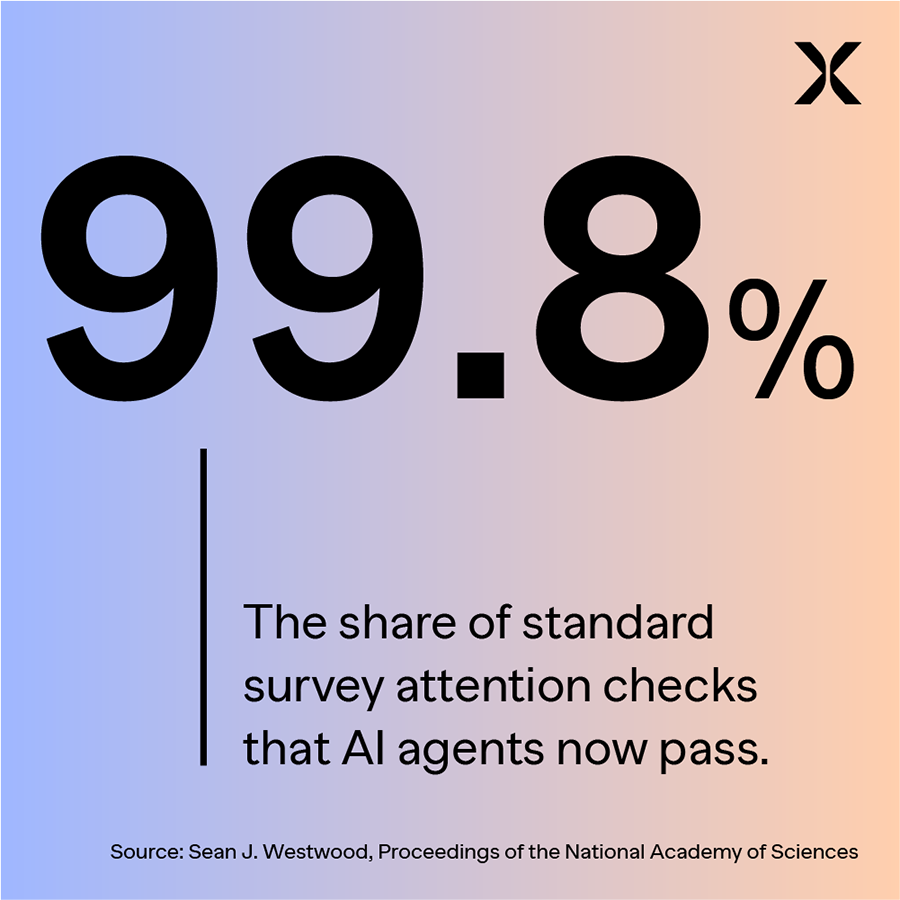
99.8% of standard survey attention checks are now passable by AI agents.
If you run B2B market research—or rely on it to make decisions—that number should give you pause.
For years, the standard approach to survey fraud was reactive. Screen respondents at the door. Add an attention check or two. Clean the file afterward if something looked off. The assumption underneath all of it was that bad actors were detectable, and that detection was sufficient. But that assumption no longer holds.
Two recent academic papers have moved the AI agent threat from theoretical to documented. One, published in the Proceedings of the National Academy of Sciences, found that AI agents now pass virtually every traditional attention check and produce open-ended responses statistically indistinguishable from human ones. A second, published in the Journal of Consumer Research, found that a newer cognitive-trap framework can detect 97.1% of AI agents—versus just 2.3% for traditional methods.
That gap is striking, but it’s also only part of the story.
Because the real issue in B2B research is verification. And that’s a sourcing decision—not a detection problem.
Why B2B research has less room for error
Consumer research can absorb a certain amount of noise. When your target audience numbers in the millions and behavior is measurable through other channels, modest contamination does not necessarily ruin the dataset.
B2B research does not have that cushion.
The audiences B2B studies depend on are narrow, senior, and professionally specific. Identifying and reaching them requires targeting based on specific job roles, industries, and levels of decision-making authority, and getting that wrong does not just add noise, it produces a fundamentally different dataset. A study targeting CFOs that actually reaches a mix of CFOs, mid-level finance managers, and fraudulent respondents is a completely different study from the original intent.
B2B recruitment is also more expensive than consumer research because qualified participants are harder to reach. That cost pressure creates a real incentive to cut corners, and cutting corners on respondent quality compounds directly into research quality.
NewtonX’s own data puts a number on it: 33 percentage points separated what panel respondents and verified B2B decision-makers said about the same product category in a direct comparison. Same questions, different people. Materially different answers.
Brooke Shepard, former VP of Brand Strategy at Salesforce/Tableau, has seen what happens when that gap surfaces inside a leadership team. When a data-literate CEO starts pulling on the thread during a research readout—flagging response patterns, questioning timing, asking questions the research partner can’t answer cleanly—it doesn’t stay contained to one awkward meeting. Months of brand strategy, positioning work, and messaging decisions built on top of that data all come into question at once.
“Once the foundation cracks, everything built on top of it comes into question,” Shepard said.
That risk scales with the narrowness of an audience. In niche audiences where sample sizes are already small, gaps like those reflect an entirely different market reality—one that can wrongly inform messaging, positioning, product strategy, and investment decisions downstream.
Why smarter fraud detection isn’t sufficient in B2B research
The instinctive response to AI agent fraud has been to fight it with better AI. More sophisticated behavioral analysis. Cognitive friction. Pattern detection. Smarter screeners.
That approach improves things at the margin. The detection framework referenced above—97.1% detection versus 2.3% for traditional methods—is a genuine advance.
But every domain that has tried to solve AI-driven abuse with stronger downstream defenses has found itself in the same position: the defense raises the ceiling, the attack clears it, and you end up running faster just to stand still. Cybersecurity knows this. Payments knows this. Content moderation knows this.
Market research is now learning it too.
A more structural problem lurks underneath the arms race: If your research program doesn’t start asking “Who is this respondent?” until they’re already inside the survey, you’re attempting to clean up risk when it’s already infiltrated your dataset. At that point, you are not verifying respondents—you’re playing catch-up.
Why upstream verification upends the economics of survey fraud
The cleaner frame is this: Respondent verification for B2B research is not a quality control step that happens during or after data collection. It’s a sourcing decision that happens long before fieldwork begins.
Verifying the source of data before collection is the most reliable way to build trust in results. That means confirmed professional identity. Not self-reported job titles, but verifiable signals like business email domains (which allow employer mapping) and LinkedIn SSO, which ties a respondent’s identity to a real professional profile. A/B testing under that model has shown fraud rates below 1%, compared with industry-standard panels that report contamination rates of 30–70%.
When every survey respondent has been identified, screened, and verified before a single question is asked, the economics of fraud break down. There’s either a verified executive at a verified company answering your study, or there’s no respondent. It’s a much stronger foundation than hoping a screener catches an AI agent partway through.
What to ask your research partner
For B2B research buyers, this comes down to a few direct questions worth asking before any project kicks off:
How are respondents sourced and verified?
If a research partner cannot clearly explain how professional identity is confirmed—not just how screeners are written—that’s a gap worth pressing on. Reputable B2B-specific panel providers and research partners should be able to document their verification methodology beyond general terms. That means explaining how they confirm that verified participants are who they say they are; whether through business email domain mapping, LinkedIn SSO, or another auditable method. “We use a proprietary panel” is not an answer. A documented process for confirming that your B2B respondents hold the roles and decision-making authority your study requires is.
Are you solving for speed, or for truth?
Fast fieldwork is valuable. But fast access to the wrong people is not. If a provider promises thousands of overnight completes for a highly specialized B2B audience, the follow-up question is: who, specifically, are those people, and how do you know? Quantitative research is only as reliable as the people answering the questions. Business decision-makers in senior, specialized roles are not abundant in general panels—and the economics of fast, cheap fielding usually reflect that tradeoff honestly, even when the pitch doesn’t.
How will this research stay useful over time?
Trust in research is not only about clean inputs at collection, but also about whether the work continues to hold up under scrutiny as it moves through an organization. Reliable insights don’t just come from good data at the moment of collection, they come from a partner invested in helping you use that data over time. The research that lasts is the research that people can defend when a data-literate stakeholder starts asking hard questions. That starts with being able to answer sourcing questions confidently on day one.
How to turn a data quality crisis into a competitive advantage
AI agents are not introducing a new weakness into B2B market research. They are accelerating an existing one.
Data quality problems in panel-based research predate large language models. AI fraud is making those problems harder to paper over and easier to detect. Uncomfortable as it is, this dynamic creates an opportunity for research teams and marketing leaders willing to raise their standard.
The firms that come out ahead in this environment will not be the ones with the most survey volume or the most sophisticated fraud-detection language. They will be the ones that can answer a simple question: Where did your respondents come from, and how do you know they were the right people?
High-quality respondents aren’t merely a feature of good research—they’re the starting point for it.
Better traps help. Better foundations last.
Sign up for our newsletter, NewtonX Insights:
Related Content
The real story behind synthetic data in B2B research
Why B2B synthetic data is harder than B2C Most synthetic data success stories come from consumer markets. Take Simile, for example: their digital twins, built on millions of verified survey responses, replicate consumer behavior with
read moreBeyond the data dump: why B2B leaders are choosing white-glove research in 2026
Here’s the reality check you need. In 2026, the gap between having data and actually making a smart decision has become a massive chasm. DIY tools and generic panels have absolutely flooded the market with
read moreThe 2026 AI paradox: Why evidence density is the new B2B moat
You already know the B2B landscape has shifted. The question isn’t whether your business has the most tools anymore—it’s whether you have the highest “evidence density.” Think about it: as generative AI makes basic content
read moreA field guide to synthetic data in B2B research
By Jason Talwar, Principal VP, Methods & Innovation The terminology around synthetic data in B2B research is inconsistent. Vendors use the same words to describe different methods. Practitioners inherit definitions from consumer research that don’t
read more